
August 8th, 2020
Reflection re-enacts the process of excitation and carries the stimulus over into a series of images which, if the impetus is strong enough, are reproduced in some for of expression, This may take place directly, for instance in speech or may appear in the form of abstract thought, dramatic representation, or ethical conduct: or again , in a scientific achievement or a work of art. (Jung, 1969, pp. 117, para 242)
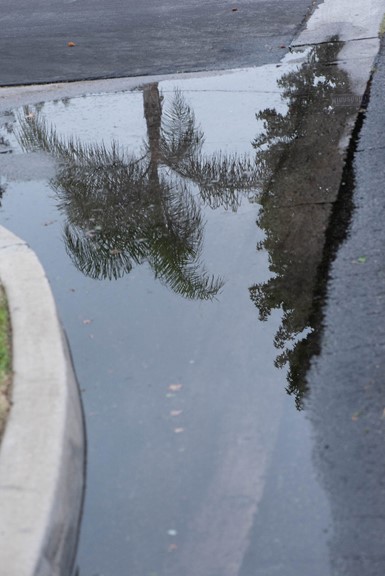
My first impression of the image leaves me wondering, what the heck? It is upside down. Then I think wait a minute, that is not right. I look at it closer and realize the image is water reflecting the trees at a street corner. I see something awfully familiar, but I must translate it to have it make sense to me. So, what is real is the grass, curb, pavement, and water. Yet what I see is more than three-dimensional reality. The trees are real, in the picture, and not really in the picture. I must reflect and interpret the image. I could have made it easier on the viewer if I took a picture of the trees or the water and not a photograph of the trees reflected in the water. Confused? Such is today’s world.
The image must be interpreted or reflected upon before it is clear. When I watch or listen to the news, I cannot take it straight in. There are filters of how life used to be and now what seems to be the new normal conflict with each other. There are many events disrupting current life; Covid-19, racial injustice protests, political disputes between parties, prolific misinformation, etc. Anticipation of what life will be in the United States seems more organic and less certain. I feel the importance of being grounded and connected to my center.
Only humans can transform their compulsive instincts into psychic structures that propel us to uniquely human response to life and its crisis. We have hunger instinct for survival, sexual instinct for procreation, action instinct to respond to life choices that call for enterprise, reflective instinct to internalize the action instinct into self-reflection and out of this comes the highest instinct of the human race- the creative instinct. The last two instincts: reflection and creation are the highest achievement of human consciousness. They are at odds with the action instinct and when we can tame our compulsive actions to respond to life, but rather take time to reflect, then it opens up the possibility of creating new paradigms to respond to the crisis.
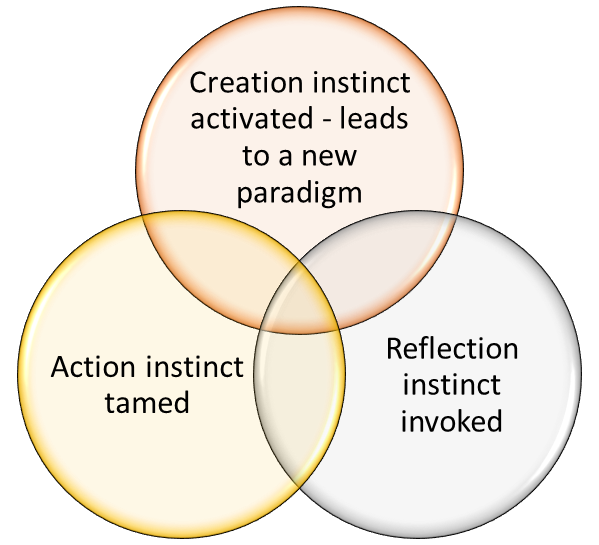
In midst of multiple crisis, it is tempting for each one of us to act in compulsive and habitual ways. We can have a white response or a black response, we may have a Democratic response or a Republican response, we can have a coastal response or a heartland response, we can have an American response or a European response: but what is your soul’s response? How do you arrive at a response, not from your head but from your heart? A response not as a Democrat or a Republication but as an American? How do you respond, not as an American but a precious link in the fragile chain of the human condition? How do you respond, not as a narcissist but as an altruist? How do you respond, not as a young partygoer but as a virtuous child to your parents and grandparents?
Each one of us must look at the so called reality in the reflective pool of our soul and turn it all around to discern what are the stable guideposts of our soul reality rather than the transient illusions of this time. When we reflect with the soul values as our coordinates, then we can sort out the fake considerations from what is enduring and creative response to the crisis we face. Every generation comes to a crossroad, and the choice we make define us for seven generations to come. This is our moment to make such a choice. We are challenged but also blessed that we can seize this opportunity to sacrifice and create a bold new world.
Points to Ponder
-
What is your anchor in these uncertain times?
-
How do you know when it is best to turn the news off?
-
How do you replenish yourself if you feel drained or depleted?
-
What kind of reflections do you have about your life?
-
How are you expressing your reflections?
-
How do you feel the compulsion to act in these multiple crises?
-
How do you tame this compulsion to act in familiar ways?
-
When you reflect on the current crisis using your deeper soul lens, what new images and options emerge for you as an individual to respond to these crises?
-
How do you implement these new possibilities?
-
What new paradigms have you created unique to your personality and circumstances?
-
Are you moving from the dynamics of action to virtues of constraint?
Photo taken in Los Angeles, CA.
Jung, C. G. (1969). The structure and dynamics of the psyche (2d ed. Vol. 8). Princeton, N.J.: Princeton University Press.
Ashok Bedi, M.D., Jungian Psychoanalyst
Robert BJ Jakala PH.D., Jungian Psychotherapist
In a storm, the safest place is in the eye of the storm. My colleague BJ and I will share our daily reflections on this centering process from an Analytical perspective, sharing from the repertoire of our personal and professional experience. BJ is a psychologist and a photographer and will pick an image of the day that catches him in this collective crisis. I will amplify it from a Jungian Analytical perspective. We hope that this may offer you a baby step on the path to your own unique response to this chaos.
© Ashok Bedi, M.D. and Robert BJ Jakala, PH. D