
April 10, 2021
I therefore think of ego-consciousness as a synthesis of various “sense-consciousness, ” in which the independence of each separate consciousness is submerged in the unit of the overruling ego. (Jung, 1960b, p. 324 para 614)
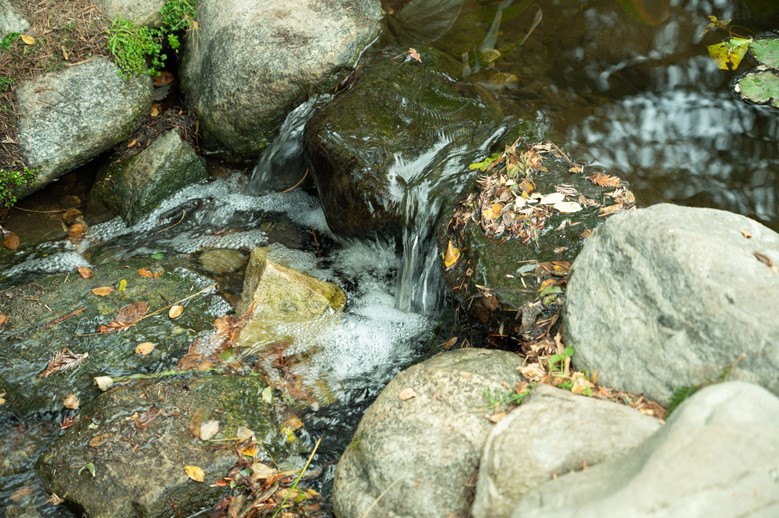
The image captures a moment of movement and stillness. The water cascades over the rocks and falls into the small pool of bubbles beneath. Some leaves are carried downstream while others rest. There are rocks with algae life on them while others are dry. Moss and small plant life grow in place along the side of the stream.
The context of the photo is absent. There are no sounds, smells, weather conditions, or geography to inform the viewer of the bigger picture. It is just a moment.
There are times when my ego is so sure of itself. I forget that my sense of who I am is limited much like the photograph. I can capture a moment and miss not only the context but also the influences and distractions of unknow parts.
In our current circumstances, there are so many external influences that pull me as well as the internal dynamics of how I see myself. I am more than the “snapshot” I see of myself. I live in a context and under the influence of so many forces.
We are never alone. We live in a community. Even when we seek solitude in the forest at the anchorite stage of life – the Sanyasi, we are in the presence of the sacred – the Brahman. In the sacred scriptures of the East,(Patañjali & Hartranft, 2003) seeking such solitude to establish a union – a state of Samadhi with the Spirit is the ultimate goal of the highest human consciousness. The capacity to cultivate silence, solitude and stillness is the central prescription of Patanjali’s Yoga Sutra,(Satchidanada, 1978)
This is the teaching of Yoga 1.1.
Yoga is the cessation of the turning of thoughts (and Cognitions) 1.2.
When Cognitions are stilled, the Soul (Atman) stands in its true identify as the witness of the universe (Brahman absolute transcendent collective consciousness) 1.3.
Otherwise, the witness identifies with the turbulence of the Consciousness – Cognitive distortions 1.4.
The instructions are to still our consciousness from the cognitive distortions, Complexes, and past perceptions and traumas intercepting our awareness of the Spirit – the Brahman or the flow of the Collective consciousness or the intelligence of the Universe.
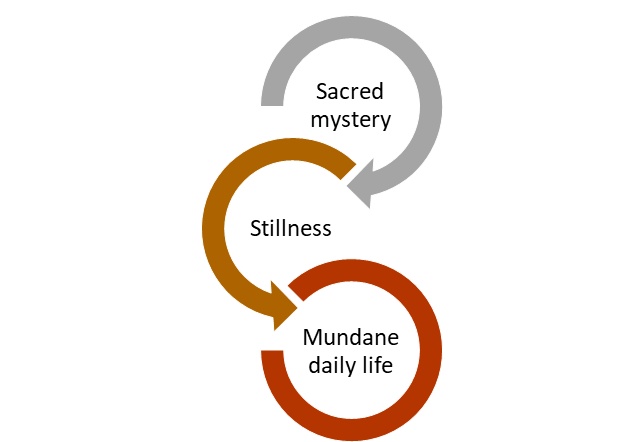
Paradoxically, when we cut off from the context of the present moment, we are connected to the source – the timeless flow of the universe. It is moment pregnant with transcendence and we move from our terrestrial to our celestial context. It is a sacred moment. We move from our ego context to our soul awareness. If we ponder on the sacredness of the contextless moment, we get connected to the mystical dimension. When we hold the memory of this mystery and return to our mundane existence, we are able to yoke our daily life to the sacred principle and our purpose in this place and at this time. It becomes our spiritual GPS. We get an intuitive sense of our purpose at this point in our life.
Points to Ponder:
- How do you view yourself?
- What cultural dynamics do you ignore, and to which do you pay attention?
- How has the pandemic influence your view of your life?
- How does the current political situation impact your view of the United States?
- What senses are the most dominant in your personal and world view?
- Do you feel that you are embedded in your present context?
- Are there moments when you sit still and disconnect from the noise and clutter of daily life?
- In such moments of stillness, how do you experience yourself and your place in the larger flow of life?
- In such moments of transcendence, do you get an intuition of your purpose and place in your life at this point in time?
- How do you embody this insight into meaningful action and service?
Jung, C. G. (1960b). The structure and dynamics of the psyche (Vol. 8). New York: Pantheon Books.
Patañjali, & Hartranft, C. (2003). The Yoga-Sūtra of Patañjali : a new translation with commentary. Boston, Mass.: Shambhala Publications.
Satchidanada, S. S. (1978). The Yoga Sutra of Patanjali. Buckingham, Virginia: Integral Yoga Publications.
Ashok Bedi, M.D., Jungian Psychoanalyst, www.pathtothesoul.com , www.tulawellnessllc.com
Robert BJ Jakala PH.D., Jungian Psychotherapist
In a storm, the safest place is in the eye of the storm. My colleague BJ and I will share our daily reflections on this centering process from an Analytical perspective, sharing from the repertoire of our personal and professional experience. BJ is a psychologist and a photographer and will pick an image of the day that catches him in this collective crisis. I will amplify it from a Jungian Analytical perspective. We hope that this may offer you a baby step on the path to your own unique response to this chaos.
© Ashok Bedi, M.D. and Robert BJ Jakala, PH. D