
July 24, 2021,
Individuation does not shut one out from the world, but gathers the world to oneself. (Jung, 1969, p. 226 para 432)

One morning on my daily walk, I saw this coyote about five hundred feet in front of me. It was sniffing the ground as it made its way along the trees. I had my camera with me and wondered if I could get a photo of it. I walked closer until I was across the road from it. I took a few images but then moved my camera away from my face and looked at it directly. We both stared at each other.
In that moment, I sensed a life-to-life connection. I wondered what its experience of me was. I felt as though I witness to true natural beauty. I was stunned, speechless, and caught in an eternal moment of the encounter. I raised my camera once more to make the photograph above. It stood still, I clicked the camera and it turned it head forward and continued its journey.
The shared moment is captured digitally, but it is also embedded in me. I can still feel the look of the coyote, a tender, quiet natural moment.
When some aspect of objective or outer reality intrigues us, engages us beyond a fleeting cognitive scan, then it is likely that it is a projection of our Soul and our portal to the collective consciousness, to the Brahman awareness, to the womb of the flow of the Universe. It must then be considered a synchronistic event, a messenger from our Soul and the Universe, alerting us to the numinous in the normal, to the sacred in the mundane, to the ocean in a drop.
Here are some reflections from the ancient Hindu scriptures of the Upanishads indicating this unitive consciousness in its varied manifestations.
The Many Projections of Self – Shvetashvatara Upanishad
The Lord (Self) dwells in the womb of the cosmos, the creator who is in all creatures (projections).
He is that which is born and to be born (teleos); His face is everywhere.
[II.16]
The Shvetashvatara Upanishad is a classic rendering of the unity of Self experienced in its many projections that our ego experiences as the objective reality – a mere hologram of the projections of the aspects of the subjective Self. This theme is amplified in myriad ways and manifestations, establishing of the unity of Self in its outer projections onto the objective reality and inner continuity with Brahman or ultimate awareness.
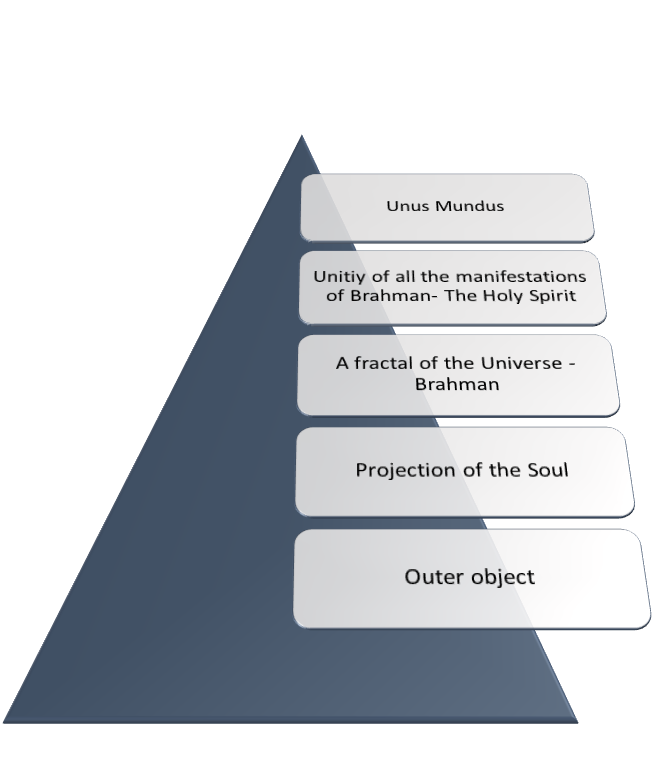
This profound ancient text guides us in the understanding this indivisible reality. All of the Universe in of the same substance and energy in its various manifestations. Why each object manifests in its present form is a subject of further exploration in the Vedanta literature and beyond the scope of todays’ theme, but has Karmic antecedents. Each manifestation of the objective reality that hooks our interest is an invitation to reclaim a closer connection to the Brahman, the source, the Holy Spirit. It should be treated with respect, reverence and reflection. Then, we could harvest the treasure in every moment. This transcendent awareness is the foundation of the Mindfulness tradition. (Bedi, 2013)
When we become aware of the unity at the core of the varied manifestations of this world Soul or Brahman, we become reconnected to the source of infinite grace and transforms our personality into its highest potential; we become the personal best version of ourselves, we become one with the Universe, the Unus Mundus. It changes our relationship with ourselves, others and the world around us. It transforms our attitude and behavior towards other species, the environment and our role in it. Contempt is transformed into compassion, I versus them is transformed into “US – WE – UNITY”. Unless we are self-destructive and ignorant, we realize that what we do unto others, we are doing it to ourselves and hurting what is part of us. Christ embodied this awareness in his precious instruction via Matthew:
Matthew 7:12 – New International Version
So, in everything, do to others what you would have them do to you, for this sums up the Law and the Prophets.
Points to Ponder:
- What was your last encounter that left you speechless?
- What other senses come into play when you have no words to describe an encounter?
- How have you gathered the world to yourself?
- In this time of the pandemic, what parts of the world have you held?
- When something catches your interest, do you reflect on what catches you about it?
- Once you become aware of why a certain object intrigues you, are you able to connect the dots and see it as some manifestation of your Soul?
- For instance, if a cayote were to intrigue you, can you connect to its symbolic instruction as an invitation by the archetype of the divine Trickster to reclaim your playful, mischievous, win-win personality?
- Do you engage this particular image or hologram of your Soul and ponder on how it connects you to the larger reality of the Universe?
- If cayote were your totem animal, do you consider playing a role in the larger community via your playful yet diplomatic psyche to attend to the problems that plague our world presently?
- Each one of us gets our own symbols and instructions from the Universe; what is your symbol, totem, object of intrigue?
- Once you decode your image and its symbolic dimension, do get intrigued and just talk about it or do you translate it into action and Service?
- Are you talk the talk or walk the walk type of individual?
- Sometimes, we must focus on what intrigues us and at other times we may reflect on what we ignore to focus on in a certain image. So, if the cayote intrigues you, you may wonder in this image-if it were your image- what about the tree? It may be that your inner cayote is incarnate as your guiding myth to protect the “Tree of Life” that is in peril in midst of the pandemic!
-
Are you aware that once you commit to the Service in alignment with the instructions of the Spirit, that you may secure the tailwinds of the gods?
Bedi, A. (2013). Crossing the healing zone : from illness to wellness. Lake Worth, FL
Newburyport, MA: Ibis Press, a division of Nicolas-Hays, Inc.,Lake Worth, Distributed to the trade by Red Wheel/Weiser.
Eknath, E., & Nagler, M. N. (1988). The Upanishads. London: Arkana.
Jung, C. G. (1969). The structure and dynamics of the psyche (2d ed. Vol. 8). Princeton, N.J.: Princeton University Press.
Ashok Bedi, M.D., Jungian Psychoanalyst,
www.pathtothesoul.com , www.tulawellnessllc.com
Robert BJ Jakala PH.D., Jungian Psychotherapist
In a storm, the safest place is in the eye of the storm. My colleague BJ and I will share our daily reflections on this centering process from an Analytical perspective, sharing from the repertoire of our personal and professional experience. BJ is a psychologist and a photographer and will pick an image of the day that catches him in this collective crisis. I will amplify it from a Jungian Analytical perspective. We hope that this may offer you a baby step on the path to your own unique response to this chaos.
© Ashok Bedi, M.D. and Robert BJ Jakala, PH. D
Paragraph