August 27, 2021
Man “possesses” many things which he has never acquired but has inherited from his ancestors. He is not born as a tabula rasa; he is merely born unconscious. But he brings with him systems that are organized and ready to function in a specifically human way, and these he owes to millions of years of human development. Just as the migratory and nest-building instincts of birds were never learnt or acquired individually, man brings with him at birth the ground-plan of his nature, and not only of his individual nature but of his collective nature.(C. G. Jung, 1961, p. 315 para 728)
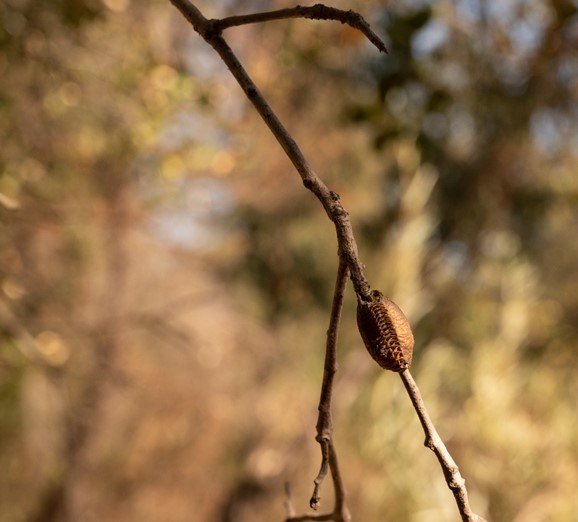
The image of the empty praying mantis nest reminds me of many abilities that are stored in our human DNA. Jung (1961) wrote of humanity having abilities that are unconscious and “ready to function”. The female praying mantis knows how to build a nest and deposit each egg into its own compartment for development. When the time is right, the eggs hatch, and climb out of nest, as noted by the holes in it. There is no parenting of them. They are left to grow and develop on their own. Their DNA guides them from birth to death. There is deep knowledge activated to support its life and the life of the species.
During the current world situation of the pandemic, social unrest, and political turmoil perhaps there is knowledge to come forward that has not been taught. Perhaps there is something that will emerge out of the unconscious to help me survive and grow from these trying times. When I maintain a sense of curiosity, my ego is more receptive to whispers from the other side of consciousness. I am often uncomfortable stepping into the unknown, yet it is the way to learn more about myself and my participation in the collective.
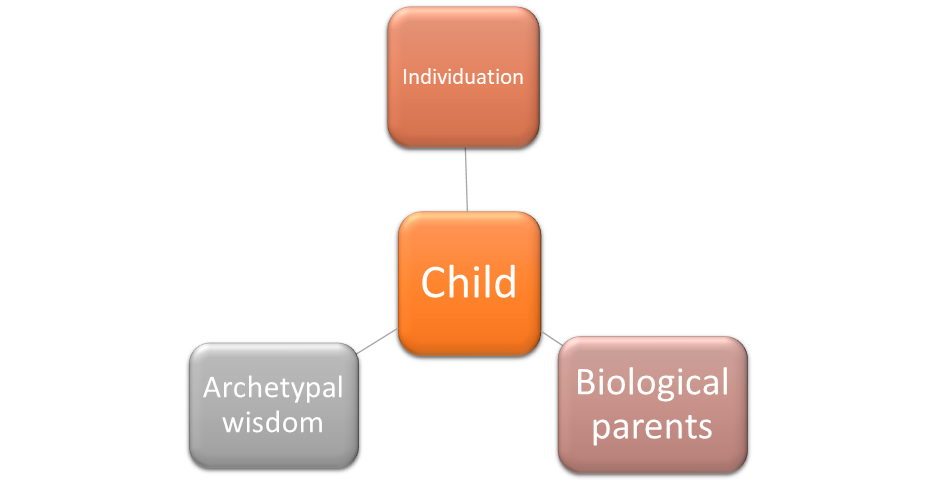
We are never alone. Every human being is the child of their biological parents and a child of the Universe. Each one of us has 30 trillion cells. Each of our cells has its own cellular wisdom and memory. Each child is born with immense cellular memory, ancestral wisdom and archetypal guidance. The biological parents may support this reservoir of innate paradigm or intercept it. That is a choice parents must consciously make. They may do so by recognizing and amplifying the archetypal potentials of their children or impose their own distorted paradigms upon them. They may become a part of their problem or support the unique solutions each child brings to the table of consciousness. How this mode of parenting may be implemented is subject of a broader and a different dialogue then the intent of today’s blog, but we want to raise awareness of this possibility.
Other than the parental dimension of our crisis and trauma management paradigm, there is a much larger component of the innate, archetypal source of guidance that is the phylogenetic endowment of every individual. This is the default mode of the unconscious. However, it is the burden of consciousness or our ego complex to acknowledge, discern and implement these whispers of our soul and the guidance of the collective consciousness. Here we are fortunate to have many viable frameworks to tap into this source. Every culture, religion and spiritual tradition offers such a path. Many schools of depth psychology offer a useful GPS for such a discernment. Hinduism offers the path of the Vedas, Vedanta(Parthasarathy, 2015), Samkhya(Kapila, 2016 (1850); S. Radhakrishnan & Moore, 1957), Patanjali’s Yoga Sutra(Baba, 2010; Bryant, Patañjali, & Patañjali, 2018; Finger, 2018; Satchidanada, 1978), and the Upanishads(Eknath & Nagler, 1988; Müller, 1879; S.-E. Radhakrishnan, 2019). Christianity offers Biblical guidance, Buddhism, Judaism, Islam, Jainism, Sikhism and all other great traditions offer their unique GPS. Many other extinct traditions have their unique contribution which humanity may well benefit from researching and amplifying. We sit on a gold mine of wisdom and guidance, and we have just scratched the surface of this dynamic.
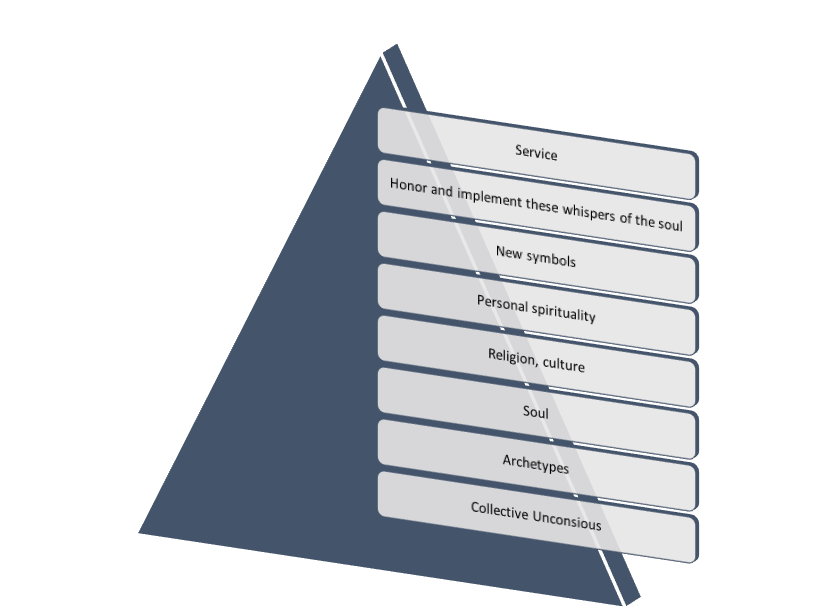
Ultimately, each one of us must evolve their unique, individualized path to this source, via the individuation process, cultivation of a personal spirituality and a system to decode the symbols of the soul and the collective consciousness. This cultivation of a personal system of spiritual discernment is called the Tantra(Feuerstein, 1998; Carl G. Jung, 1996; Sharma, 1986; Woodroffe, 1978) or the sacred instrument of consciousness.
Carl Jung’s Analytical psychology offers a unique framework for integrating these cross-cultural paradigm of these unique vectors into a trajectory of a personalized GPS – the Individuation process. Future scholars may yet come up with more updated systems. It offers a symbol discernment system respectful of all traditions. It does not purport to offer gold but a gold or rather a soul-mining system, using the materialistic language for a Spiritual Materia. A brief synopsis of the Analytical approach is beyond the scope of this brief blog, but readers may benefit from some introduction to the basics of the Jungian thought. (C. G. Jung, 1993; C. G. Jung, Franz, Henderson, Jacobi, & Jaffé, 1964; C. G. Jung, Hull, & Jung, 1966; C. G. Jung & Jaffé, 1963)
Each one of us may create a sacred vessel for our process of tapping into the depths of our unconscious. This may include rituals of silence, solitude, studio time, journaling, attention to dreams, synchronistic events, symbolic dimension of medical and psychiatric symptoms and relationships, Mandalas and some familiarity with the contemplative practices of your tradition. I have amplified these approaches in several publications. (Bedi, 2000, 2007, 2013; A. Bedi, Jakala, Robert BJ. , 2020; Bedi & Matthews, 2003; A. P. Bedi, Joseph A. , 2020)
On our crowded little planet with 8 billion humans and 25 million life forms, there is a perceived scarcity of resources. The outer scarcity is a mirror reflection of our inner deprivation. The real poverty is the paucity of our imagination. Imaginatio offers a blueprint of the unconscious template for outer life. When we tap into the inner resources of our personal and the collective consciousness (hitherto mislabeled as unconscious – our limited consciousness may not comprehend the universal consciousness; so, we call it the unconscious), it provides us a treasure map of creative ways of exploring, innovating and cultivating and sharing the outer resources. The real poverty in our world is the poverty of imagination and respect for the riches of our so-called collective unconscious. Hence, we live in scarcity embedded in abundance. Here is a quote from the Isha Upanishad to attend to this dilemma,
All this is full. All that is full.
From fullness, fullness comes.
When fullness is taken from fullness,
Fullness still remains.
(Eknath & Nagler, 1988), page 56
Points to Ponder:
-
What instincts do you follow/trust?
-
How do you recognize your innate abilities?
-
What connections do you have with your unconscious? (Symptoms, dreams, active imaginations)
-
What previously unknown aspects of yourself come forward during these times?
-
What vessel have your created to tune into the contents and the gifts of the unconscious?
-
How does your unconscious speak to you?
-
Do you pay attention to the symbolic dimension of your dreams, imagination, synchronicities, medical and psychiatric symptoms, relationships and your creative process?
-
What religious or cultural system guides your path to the soul and the wisdom of the unconscious?
-
What are the building blocks of your personal spirituality?
-
What symbols have crystallized into your consciousness to guide your path in difficult times?
-
What are the contemplative practices you subscribe to?
-
Do have some familiarity with a sacramental path, e.g., prayer, centering prayer, yoga, pranayama, meditation, mindfulness, tai chi, etc.?
-
How has your unconscious guidance offered you some new possibilities of being, relating, acting and service?
Baba, B. (2010). Yogasutra of Patanjali: With Commentary of Vyasa. Delhi, India: Motilal Banarsidass.
Bedi, A. (2000). Path to the soul. York Beach, ME: S. Weiser.
Bedi, A. (2007). Awaken the Slumbering Goddess – The Latent Code of the Hindu Goddess Archetypes: BookSurge.
Bedi, A. (2013). Crossing the healing zone : from illness to wellness. Lake Worth, FL
Newburyport, MA: Ibis Press, a division of Nicolas-Hays, Inc.,Lake Worth
Distributed to the trade by Red Wheel/Weiser.
Bedi, A., Jakala, Robert BJ. . (2020). In the Eye of the Storm – Staying Centred in in Personal and Collective Crisis. Sacramento, California: Mandorla Books.
Bedi, A., & Matthews, B. (2003). Retire your family karma : decode your family pattern and find your soul path. Berwick, Me.: Nicolas-Hays.
Bedi, A. P., Joseph A. . (2020). The Spiritual Paradox of Addiction: The Call of the Transcendent (Second edition (March 15, 2020) ed.). Lake Worth, FL, USA: Nicolas Hayes Inc.
Bryant, E. F., Patañjali, & Patañjali. (2018). The Yoga sūtras of Patañjali : a new edition, translation, and commentary : with insights from the traditional commentators. New Delhi: Macmillan.
Eknath, E., & Nagler, M. N. (1988). The Upanishads. London: Arkana.
Feuerstein, G. (1998). Tantra, The Path of Ecstasy. Boston and London: Shambala.
Finger, A. N., Wendy. (2018). Tantra of the Yoga Sutra – Essential Wisdom for Living with Awareness and Grace. Boulder, Colorado, USA: Shambala Boulder.
Jung, C. G. (1961). Freud and Psychoanalysis. Princeton: Princeton University Press.
Jung, C. G. (1993). The Basic Writings of C. G. Jung (Modern Library) (Series: Modern Library ed.): Modern Library; Reprint edition.
Jung, C. G. (1996). The Psychology Of Kundalini Yoga, Notes of the Seminar Given in 1932 by C.G.Jung. (Bollingen Series XCIX ed.): Princeton University Press.
Jung, C. G., Franz, M.-L. v., Henderson, J. L., Jacobi, J., & Jaffé, A. (1964). Man and his symbols. London: Aldus Books ; Jupiter Books.
Jung, C. G., Hull, R. F. C., & Jung, C. G. (1966). Two essays on analytical psychology, Volume 7 (2 ed. Vol. 7). London: Routledge & Kegan Paul.
Jung, C. G., & Jaffé, A. (1963). Memories, dreams, reflections. London: Collins and Routledge & Kegan Paul.
Kapila. (2016 (1850)). A Lecture on the Sankhya Philosophy. Mirzapure, Benaras University, India: Wentworth Press.
Müller, M. (1879). The Upanishads, Part 1 (SBE01),. Retrieved from https://www.sacred-texts.com/hin/upan/index.htm
Parthasarathy, A. (2015). Vedanta treatise : The eternities (17th ed.). London: Vedanta Institute.
Radhakrishnan, S.-E. (2019). The Principal Upanishads (S. Radhakrishnan Ed. 32nd impression – 2019 ed.). India: Indus / Harper Collins India; New edition (January 1, 1994).
Radhakrishnan, S., & Moore, C. A. (1957). A source book in Indian philosophy. Princeton, NJ: Princeton University Press.
Satchidanada, S. S. (1978). The Yoga Sutra of Patanjali. Buckingham, Virginia: Integral Yoga Publications.
Sharma, P. V. (1986). Haramekhala – tantra (the first chapter on medicine). Anc Sci Life, 5(3), 143-150.
Woodroffe, J. G. (1978). Shakti and Shakta. New York: Dover Publications.
Ashok Bedi, M.D., Jungian Psychoanalyst,
www.pathtothesoul.com , www.tulawellnessllc.com
Robert BJ Jakala PH.D., Jungian Psychotherapist
In a storm, the safest place is in the eye of the storm. My colleague BJ and I will share our daily reflections on this centering process from an Analytical perspective, sharing from the repertoire of our personal and professional experience. BJ is a psychologist and a photographer and will pick an image of the day that catches him in this collective crisis. I will amplify it from a Jungian Analytical perspective. We hope that this may offer you a baby step on the path to your own unique response to this chaos.
© Ashok Bedi, M.D. and Robert BJ Jakala, PH. D