September 26, 2021
Symbols are not allegories and not signs; they are images of contents which for the most part transcend consciousness. We have still to discover that such contents are real, that they are agents with which it is not only possible but absolutely necessary for us to come to terms. (Jung, 1956, p. 77 para 114)
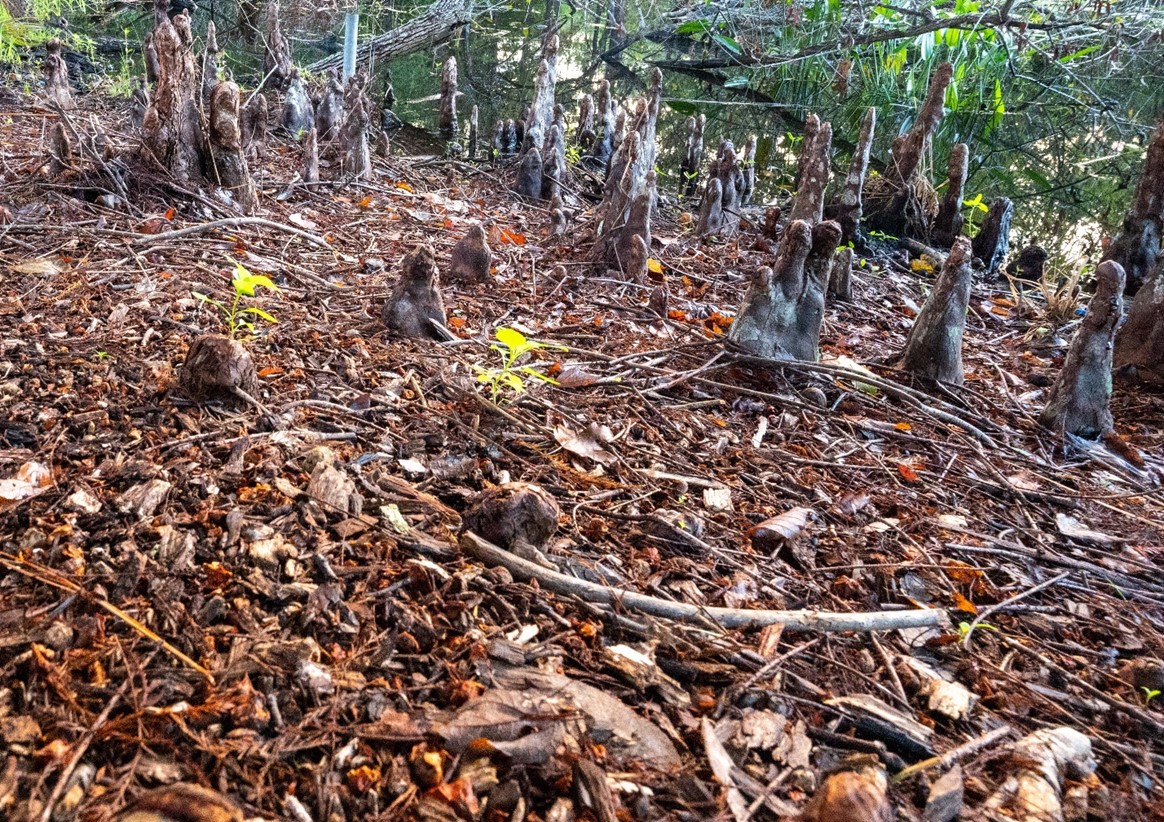
The unknown qualities in this image tickle my curiosity. I look for items I can identify through familiarity. I begin the processes of organization and categorization to answer what the items are, their origin, and function. I see their current state and I imagine how they came to the place of the forest floor, and their current purpose. Most of the items are elements of the cypress forest that have fallen to the ground. Then there are elements that do not fit into that explanation or understanding.
What are those protrusions that have sprung up from the ground? They look like surreal sculptures that sit on the forest floor. They are called cypress knees and are part of the root system of the cypress tree that grow above the surface, unlike most of the root system that anchors the tree and never sees the light of day.
I look to their size, shape, color, and texture to match the world I know. Yet, the limit of my knowledge invites the desire to know more about them. I search the internet and discover science has several theories and possibilities, but nothing clearly conclusive. As a result, I find my imagination activated. Still, I want to “come to terms” (Jung) and settle the questions.
I then use the image to understand the value of a symbol in my dream life. Since I cannot find clear answers, I am led to the open questions “how does the transformation of an underground root move to grow above ground? Or what is the purpose of the knee in that particular place?” I find myself in a parallel process when I remember a dream. There are elements that are unexplainable to my conscious mind, yet they are elements from the unconscious that have erupted. The dream contents are alive, just as the cypress knees, and activate my desire to understand the function and meaning to my conscious mind.
I imagine the science of botany will find an answer someday. In the meantime, we are left in the field of discover and curiosity. It is this cutting edge of curiosity to comprehend the unknown that creates our new universe of possibilities to incarnate our emergent personality. This curiosity is the steppingstone into the realm of what is not yet known. Not knowing – as Krishnamurthy says – is the path to deeper knowing. The seekers of the soul yield to an investigation of this curiosity by reflecting function of our psyche.
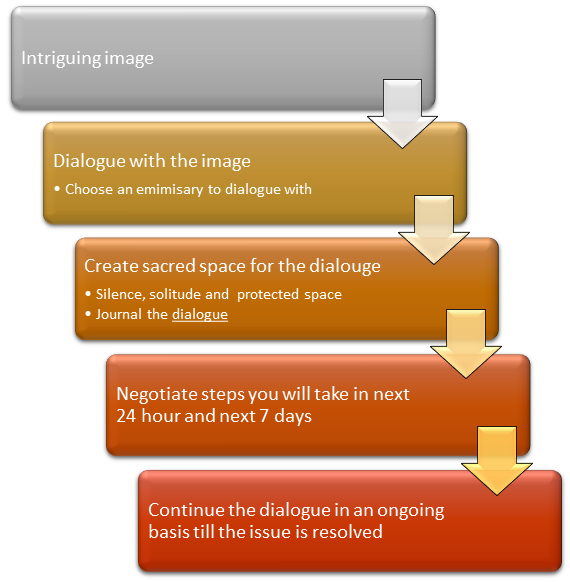
We must choose an emissary from this realm of the unknown and create sacred space to dialogue with it. We must then journal this dialogue and amplify it with archetypal motifs. Eventually, it will yield its mystery – not total mystery but bits that are relevant to our unique individuation process, achieving selfhood and become the best possible version of us. Let me share a sample of such an active imagination. I have chosen the cypress knee with three heads as my protagonist from the symbolic realm. I will call it the Trident. I create a sacred space, solitude and silent time to have a dialogue with the Trident. Here is a small sample of the extensive dialogue. Here is an excerpt from my journal.
Me: Hello Trident. Thank you for manifesting in my life. I honor you and request that we sit down and talk. I am very curious about your visit to my psychic home.
Trident: you are welcome. I am looking forward to our meeting.
Me: What made you decide to grace me with your presence?
Trident: You called me when you prayed last night to help you with the X-Project.
Me: Ah, yes; I have been struggling to make some decisions about the next step in this project. I feel that I am at a crossroad.
Trident: I know, it is a difficult junction to navigate. You will have to be decisive and use my thunderbolt to destroy your long attachment to the Y-Project so that you may devote your full attention to the X-Project!
Me: So, you want me to exercise the Trident of Shiva and Zeus to destroy my enmeshment in the Y-Project to make room and energy for the X-Project. You may have to destroy this old universe to make room for the new project.
Trident: Yes. The old must be destroyed to make room for the new.
Me: What is the first step you suggest I take?
Trident: Well, how if you resign from your membership in the Z-Club for starters. It has outlived its relevance in your life. It is draining your energy and resources. Let go.
Me: Thank you. Will do before the week is out. I will draft a letter to them before the day is out. May I consult you again as I proceed with the X-Project?
Trident: I am your friend. Call me at 1 877 TRIDENT. I will show up in your dreams to help you.
Me: Thank you!
This is a dialogue with the archetype of Shiva, the destroyer of the old order to make room for the new creation. It must be followed by reflection and measured action in a timely manner to keep the portal alive for an ongoing dialogue and receive guidance from the wisdom of our depths. Jung describes this process of Active Imagination in detail when he cultivated this method in his dark night of the soul (Jung, 1969)which he archived in his Red Book. (Jung & Shamdasani, 2009)
Points to Ponder:
- What is your response to a symbol?
- What activates your curiosity?
- How does amplification inform your consciousness?
- What kind of relationship do you have to curiosity?
- How does the phrase “more to be discovered” impact you?
- How do you make room to dialogue with the symbols that intrigue you?
- Do you have a ritual of silence, solitude and sacred space for such a dialogue with the emissary of the image that calls upon your curiosity instinct?
- Do you journal this dialogue and get some guidance and prescriptions for a dilemma in your present life?
- Do you decisively implement this inner guidance in the next 24 hour and then a detailed response in next 7 days?
- Do you make room for a continuing dialogue with this emissary from your Soul?
- How does it feel to implement this guidance?
- How does it impact your game plan?
Jung, C. G. (1956). Symbols of transformation; an analysis of the prelude to a case of schizophrenia (Vol. 5). New York: Pantheon Books.
Jung, C. G. (1969). The structure and dynamics of the psyche, Volume 8 (2d — ed. Vol. 20). Princeton, N.J.: Princeton University Press, pages 67-91
Jung, C. G., & Shamdasani, S. (2009). The red book = Liber novus (1st ed.). New York: W.W. Norton & Co.
Ashok Bedi, M.D., Jungian Psychoanalyst,
www.pathtothesoul.com , www.tulawellnessllc.com
Robert BJ Jakala PH.D., Jungian Psychotherapist
In a storm, the safest place is in the eye of the storm. My colleague BJ and I will share our daily reflections on this centering process from an Analytical perspective, sharing from the repertoire of our personal and professional experience. BJ is a psychologist and a photographer and will pick an image of the day that catches him in this collective crisis. I will amplify it from a Jungian Analytical perspective. We hope that this may offer you a baby step on the path to your own unique response to this chaos.
© Ashok Bedi, M.D. and Robert BJ Jakala, PH. D