October 22, 2021
It is only because the persona represents a more or less arbitrary and fortuitous segment of the collective segment of the collective psyche that we can make the mistake of regarding it in toto as something individual. It is, as its name implies, only a mask of the collective psyche, a mask that feigns individuality, making others and oneself believe that one is individual, whereas one is simply acting a role through which the collective psyche speaks.(Jung, Hull, & Jung, 1966), para 245
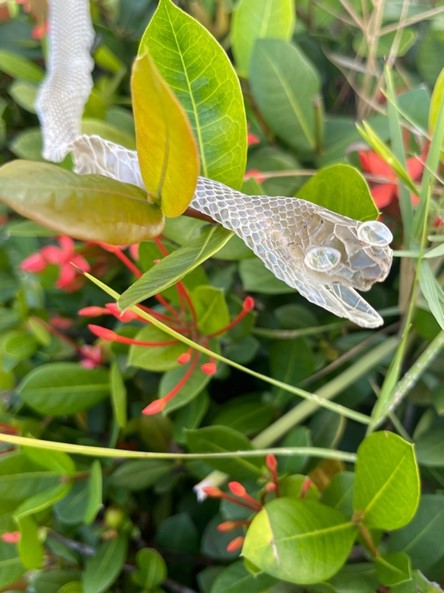
What a surprise to discover a 5-foot snakeskin in the bushes. I do not know what kind of snake shed its skin. (It may be a black snake which is common in the area.) I do know that is has outgrown this shell of its existence.
I begin to wonder what it means to I find this symbol of transformation. There are two ideas that come to mind. First, the snake has a new skin and subjectively it feels freedom from what no longer suits it. Second, I think about what skin I would like to shed to feel the freedom of a contemporary me.
The image is a bit scary as well as beautiful. There is a blend of terror and hope. It certainly is spooky yet reminds me how it feels to let go of something that no longer suits me. I feel clean and refreshed. I imagine myself stepping out of the “shell” I have been in, and how the dynamics of the world and me would shift. My potential would feel closer to realization. I would be more of who I am without the burden of what no longer fits.
For every occasion, there is an outfit. For a walk, you wear sneakers, for your office, you wear formal shoes, for the evenings, you have informal attire, for your wedding, you must donn your wedding gown, ad infinitum. These are not mere masks but essential to adapt and honor the situation. For every season, there is an outfit, in winter we wear heavy clothes, in summer we wear light. Every place has its attire, every country has its unique wardrobe. The dynamic of the thousand masks we must wear is no mean business. For every stage of life, there is a Persona, relevant to our stage of life. A professional mask, a parental mask, a public mask and even a private mask in the most intimate of encounters! It raises a million questions.
How do we choose this mask? Are we still authentic when we are masked? Should we be constant or consciously donn different personas? How do we discern what is appropriate for the moment, season, occasion, role, and yet be true to our soul?
Every persona has a purpose. The firefighter must wear their gear to fight fires, a soldier to win battles, the doctor to heal the illness, a father to roll up his sleeves to help his children, a mother to nurture her wards. So the primary purpose of our persona is to attend to the responsibilities in the outer world. The second purpose is personal comfort and safety while attending to the task, season and the occasion in a given culture and context. The core purpose of the persona is to be true to your soul. Often, these considerations are aligned. When there is a discrepancy between the demands of the outer and inner adaptations, a tension pole is set up in our psyche. Then a bridge must be build between these poles of the opposites.
Setting up a bridge between the poles of the opposites in persona making is only partially a conscious enterprise. Most of this process is unconscious. It sets up a transcendent function autopilot in our unconscious to align these competing poles. Some uniting symbol arises to align these poles in a new third position unique to each one of us – aligned to our soul’s calling. The divine Trickster archetype of Hermes or Krishna unites these opposites to create a new persona and shed the old skin. This guidance may come via a dream, a synchronistic event, a creative product etc.
Another crucial question still lingers. What mask do we wear when we are with “me”? Who is this me? Here we have the tricky question of moving from me to I. Who am I? Who am I when I am not playing a role in the outer world? Who am I in presence of the divine? This is the most challenging task of human consciousness; the mask we wear to protect me from I. This is not a deliberate act, since to unmask our true I could set in a catastrophic, existential crisis and thankfully, most of us stay oblivious of this unmasking in this lifetime. We live out a role rather than meet the I.
The process of gradually unmasking of the me to meet the I is a profound spiritual undertaking, usually engaged by sensitive, neurotic, creative and great individuals. Their life story becomes paradigmatic to guide the rest of us, but at the end, each one of us must make this pilgrimage to the soul by constructing our own map. Every religion, every tradition, every prophet, every leader lay out and account of their journey, that we may consult, but to reach the true I, we must struggle to find our own path. We may watch a thousand videos of others climbing Mount Everest, but if you wish to claim your mountaintop, you must make your own journey. Often, we must go through the crucial stage of being “Nobody” to shed all the snake skins till the soul skin grows, or not. Perhaps when me meets I, we do not need a mask. Hindus call this a state of Samadhi. Perhaps, we may discuss this state another day in context of another image.
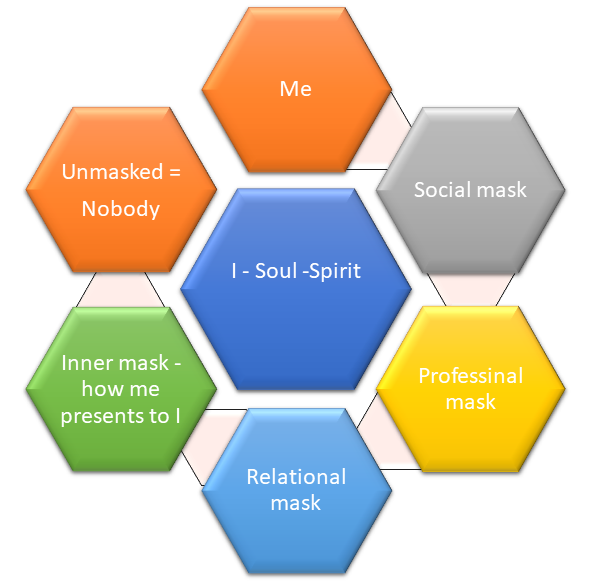
Points to Ponder:
- What would inform you it’s time to shed your old skin?
- What aspects of your life would you like to shed?
- What kind of support would you want?
- What would the world notice if you did it?
- What would you notice?
- When was your last transformation?
- What are the different roles you see yourself in your present life?
- What persona you present to the world in your different roles?
- What is your persona that you present to yourself?
- Have you ever experienced yourself as “Nobody”?
- What does be Nobody feels like?
- Is Nobody a feeling of joy, despair, inquiry, intrigue or mystery?
- How do you feel in relation to the sacred of your understanding when you are a Nobody?
Jung, C. G., Hull, R. F. C., & Jung, C. G. (1966). Two essays on analytical psychology, Volume 7 (2 ed. Vol. 7). London: Routledge & Kegan Paul.
Ashok Bedi, M.D., Jungian Psychoanalyst,
www.pathtothesoul.com , www.tulawellnessllc.com
Robert BJ Jakala PH.D., Jungian Psychotherapist
In a storm, the safest place is in the eye of the storm. My colleague BJ and I will share our daily reflections on this centering process from an Analytical perspective, sharing from the repertoire of our personal and professional experience. BJ is a psychologist and a photographer and will pick an image of the day that catches him in this collective crisis. I will amplify it from a Jungian Analytical perspective. We hope that this may offer you a baby step on the path to your own unique response to this chaos.
© Ashok Bedi, M.D. and Robert BJ Jakala, PH. D