August 7, 2021
Dreams have a psychic structure which is unlike that of other contents of consciousness because, so far as we can judge from their form and meaning they do not show the continuity of development typical of conscious contents. (Jung, 1960b, p. 237 para 443)

“What was that?” and/or “What is that?” are familiar first questions of my morning. When I wake up, I generally recall images that loiter from the nights’ dream adventures. There are portions available in my memory but then I am unclear as to where in the dream movie they occurred. The puzzle pieces are glimpses but are not fully connected. I work to recall as much content as possible including the sounds, feelings, and thoughts of those dreamt moments. When I revisit a dream, it is more of a brainstorm. It is often not linear progress but rather chaotic or circuitous. I write down as many aspects of it as possible without the use of a sense-making filter. Each time I make notes about dream, I go back to Jung’s words in the above quote. The psychic structure of a dream does not follow typical logic.
When I consider life in the United States right now. I must treat it like elements of a dream that come from foreign or unfamiliar territory. The timeline of progress is not linear from bad to good or from good to bad. There are some situations that feel stagnant or like a perpetual lost cause. In this challenging time, I rely on my resources, internal and external, to guide me through the eruptions and the ripple effects. The psychic structure of our country has been guided by the constitution, but for some only certain aspects apply. They disregard pieces to suit their emotional/political needs.
My task during these wavering times is to understand my life and the glimpses of my future life as revealed/hinted by dreams or the fragments I have from active imagination. I dialogue with my inner constitution and at times make amendments to aspects that no longer fit into the person I am or the one I am about to become. I pay attention to those elements that erupt from my inner world or those that dive in from the external life. When I pay close attention, it seems both occur at the same time.
A dream or fantasy is a splash of new emergence on the surface of consciousness that is dark and confusing. It beckons us to investigate it further. It is a message from the depths our unconsciousness, and furthermore, even from the depths of the collective unconscious, from the womb of our cumulative human civilization that brings this timeless, archetypal memory to bear of the intractable problems we face today in our personal and collective lives. It is a precious instruction that we ignore at our own peril. If we engage it, we respond to our challenges from the wisdom of the depths. We are less likely to repeat the errors of the past that our ancestors worked out via trail and error over millions of years. (Stevens, 1993)
A dream and fantasy add information from this archetypal data base to complement, compensate, amplify, alert, support, avert, suggest alternatives and new possibilities to deal with the challenge at hand. It is an X-Ray of possibilities and alternatives.(Bosnak, 1998; Jung, 1974, 2010; Mattoon, 1978; Whitmont, 1992) This is the healing power of the unconscious, of the Brahman consciousness, of the depths. It is the emergence of the numinous. It is the path to the soul. (Bedi, 2000)
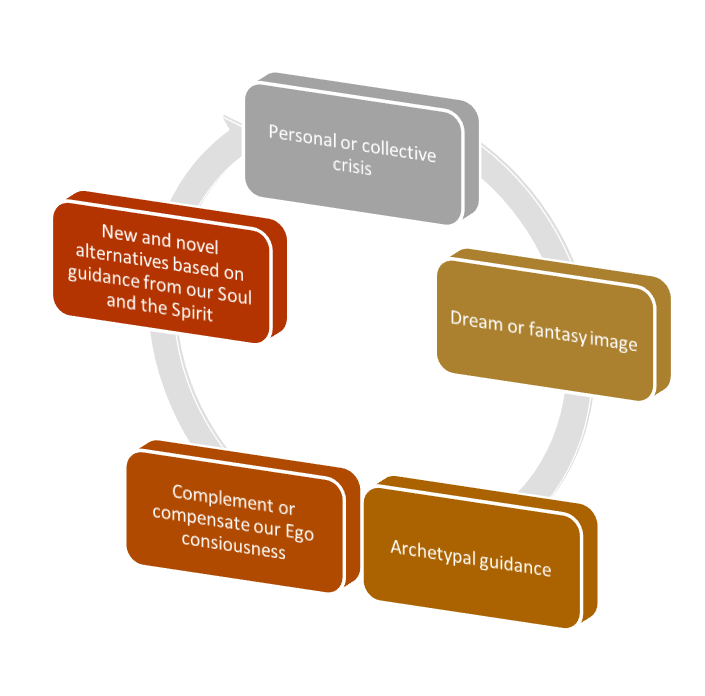
To harvest this gold of the unconscious, we must treat these images with reverence and gravitas. We must honor their numinous, guiding potential. We need to dialogue with these images, journal them and implement their instructions as best as we understand them. This establishes a feedback loop with the unconscious. It sets up a consultative paradigm with our soul and the spirt. It reminds us that we are not alone in journey of life, that we have a senior partner with experience, wisdom and infinite resources to guide and support us. (Bedi, 2013)
Points to Ponder:
- How do you engage your dreams or dream fragments?
- When you look at the image, what is your experience of it?
- What feeds your life?
- What aspects of you are a work in progress?
- What elements of you are fully formed and anchored in who you are?
- How do you treat this dream image? With reverence or neglect?
- Do you dialogue with this image?
- What is your fantasy about this image?
- What information does it add to a problem you are currently struggling with?
- What new possibilities does your amplification of this image add to your management of the problem?
- Do you act on this new insight?
- How does that new insight modify what you were planning to do?
Bedi, A. (2000). Path to the soul. York Beach, ME: S. Weiser.
Bedi, A. (2013). Crossing the healing zone : from illness to wellness. Lake Worth, FL
Newburyport, MA: Ibis Press, a division of Nicolas-Hays, Inc.,Lake Worth
Distributed to the trade by Red Wheel/Weiser.
Bosnak, R. (1998). A Little Course in Dreams (Later Printing edition ed.). USA: Shambhala;.
Jung, C. G. (1960b). The structure and dynamics of the psyche (Vol. 8). New York: Pantheon Books.
Jung, C. G. (1974). Dreams (Published by MJF Books, N.Y. ed.). USA: Princeton University Press.
Jung, C. G. (2010). Children’s Dreams: Notes from the Seminar Given in 1936-1940 (Jung Seminars). USA: Princeton University Press (September 12, 2010).
Mattoon, M. A. (1978). Understanding Dreams (Spring Editions 1984 ed.). Woodstock, Connecticut: Spring Publications.
Stevens, A. (1993). The two million-year-old self. College Station: Texas A&M University Press.
Whitmont, E. C. P. S. B. (1992). Dreams, A Portal to the Source (1 ed.). London and New York: Routledge;.
Ashok Bedi, M.D., Jungian Psychoanalyst,
www.pathtothesoul.com , www.tulawellnessllc.com
Robert BJ Jakala PH.D., Jungian Psychotherapist
In a storm, the safest place is in the eye of the storm. My colleague BJ and I will share our daily reflections on this centering process from an Analytical perspective, sharing from the repertoire of our personal and professional experience. BJ is a psychologist and a photographer and will pick an image of the day that catches him in this collective crisis. I will amplify it from a Jungian Analytical perspective. We hope that this may offer you a baby step on the path to your own unique response to this chaos.
© Ashok Bedi, M.D. and Robert BJ Jakala, PH. D