August 22, 2021
It seems to me that we have really learned something from the East when we understand that the psyche contains riches enough without having to be primed from outside, and when we feel capable of evolving out of ourselves with or without divine grace….We must get at the Eastern values from within and not from without, seeking them in ourselves, in the unconscious. Because of these resistances we doubt the very thing that seems so obvious to the East, namely, the self-liberating power of the introverted mind. (Jung, 1969, pp. pp.484-485, para 773)
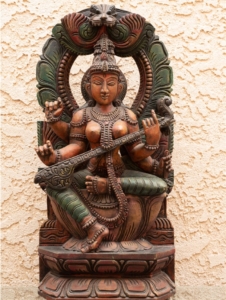
The image is the Hindu goddess Saraswati. “She is the patron of speech, knowledge, the creative and performing arts, and is depicted as carrying a veena, one of the oldest string instruments” (Bedi, 2007, p. 60). I have several images of her in my house. I see each of them as a mirror of the conscious and unconscious energy she represents in me. When I utilize the words of Jung above, something else happens; she is a projection, not a reflection. The image of Saraswati is a visual stimulation to my neural pathways of creativity and learning. She activates my source of mystery and my wanting to know more, be more, create more. She is a part of me that externally reminds me of my soulful journey.
Jung’s work demonstrates the spiritual nature of humanity. When I search deep inside there is a place before words can be formed. It is a place of connection to more of me than I am consciously aware of yet sense its presence.
Jung recommended that the seekers of the soul’s mystery get well versed in their own cultural and religious traditions but additionally study at least one other tradition, religion or culture as a frame of reference to deepen their understanding of their own tradition as well as have a comparative frame of reference. The other tradition provides a balancing experience. It fills in the gaps in our tradition. It patches up the blind spots every religion has. It provides a screen to project the lost continent of our soul. More distant a tradition we choose, more likely it is to resonate with the deepest recesses of our unconscious. Nature is wise. It gave us two eyes, two ears, two hands, two legs, two sides of our brain; there must be a reason for this. This duality not only provides the insurance back up for any loss of function in one side but also a depth perception of vision, hearing and dexterity. Similarly, we navigate the path to the soul better with an auxiliary tradition or religion as a back up framework to fill in our gaps.
I was raised in this duality. My family were devout Hindus. My mentors and teachers were devout Christian Jesuit fathers. From kindergarten to pre-medical schooling and beyond, I was blessed with guidance and mentoring by Jesuits. This duality has been my strength. In times of crisis, I often get dreams where Jesuits and Christ has appeared to guide my path. My patients benefit from my dual background. They often report dreams which may only be decoded when I factor in Hindu mythology over and above the Christian images and myths. They often dream of elephants when they are about to make a new enterprise. While I may not share the mythology with them, I know that the archetype of Ganesha has constellated to guide their new beginnings and remove the obstacles in their path. Ganesha is the elephant headed God of Hindus that removes obstacles and guides us in our new ventures. This gives me a broader archetypal bandwidth to interpret their dreams and symbols.
One of my patients had started a new course of advanced studies. She dreamt that her teacher was a pianist as well as an engineer. It was apparent to me that Goddess Saraswati had appeared in her dream as a patron of academic process. The archetype of Saraswati also had some warnings for us in our analytical work. This individual had been married to her college professor in the past who dumped her for a younger woman. The patient had prone to fall in love with her teachers and father figures as the shadow side of Saraswati archetype. In the myth of Saraswati, her creator Brahma falls in love with his creation Saraswati with dire consequences. Women caught in the shadow of this archetype tend to get emotionally tangled with their mentors and teachers. So, this image in her dream was very helpful GPS in our work together.
In varied depictions of the Saraswati iconography in India, she is depicted as riding the peacock and later a swan. For optimal learning, particularly in advanced studies, one must ride and tame the peacock – a symbol of hubris and narcissism. Once this is accomplished, she rides the swan – the ride of the gods, an alchemic symbol of purity and spirituality in the Hindu tradition. A student must be humble to take in the wisdom of the masters. Then one constellates their swan nature. 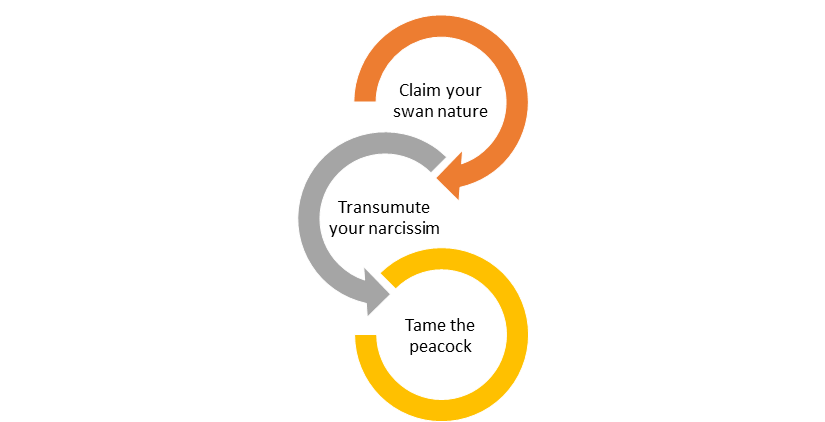
Many individuals intuitively get fascinated by other traditions. There is a deep interest in Yoga, Buddhism, meditation, mindfulness and other rituals of Eastern traditions in the West. This is psychologically a deepening experience for these individuals. They need to stay committed to their primary tradition and spiritual orientation to maximize the benefit of these comparative religious experiences.
Points to Ponder:
- What image(s) do you admire or identify with?
- What aspects of the image reflect you or a quality you want to develop?
- How do you recognize your strengths?
- What inner qualities do you acknowledge without external reminders?
- What is your primary religious or cultural tradition?
- Are you fascinated by another religion or tradition?
- Does this other tradition help you with a broader framework to untangle your life problems and challenges?
- Do you add any rituals or symbols from this fellow tradition to your psychological and spiritual toolkit?
- Give an example of such a ritual or symbol that you have found helpful in times of crisis or discernment.
Bedi, A. (2007). Awaken the Slumbering Goddess-The Latent Code of the Hindu Goddess Archetypes: Book Surge.
Jung, C. G. (1969). The structure and dynamics of the psyche (2d ed. Vol. 8). Princeton, N.J.: Princeton University Press.
Ashok Bedi, M.D., Jungian Psychoanalyst,
www.pathtothesoul.com , www.tulawellnessllc.com
Robert BJ Jakala PH.D., Jungian Psychotherapist
In a storm, the safest place is in the eye of the storm. My colleague BJ and I will share our daily reflections on this centering process from an Analytical perspective, sharing from the repertoire of our personal and professional experience. BJ is a psychologist and a photographer and will pick an image of the day that catches him in this collective crisis. I will amplify it from a Jungian Analytical perspective. We hope that this may offer you a baby step on the path to your own unique response to this chaos.
© Ashok Bedi, M.D. and Robert BJ Jakala, PH. D