August 14, 2021
If your creative force now turns to the place of the soul, you will see how your soul becomes green and how it bears wonderful fruit. (Jung & Shamdasani, 2012, p. 142)
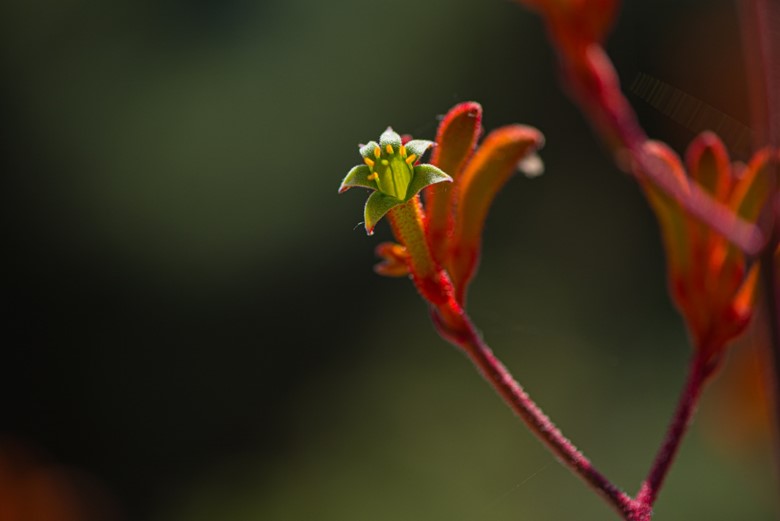
There are times I get caught up in the latest breaking news and find myself distracted from the personal and soulful life I prefer to lead. In those moments, I must pause and redirect my attention. If I am to make a positive contribution to the collective, I must ensure my creative force is active. Then, I can live out of a soulful place much like the blossom in the image. One way I do that to let go of the news with a few cleansing breaths. I imagine the news leaving me as I exhale and create a clearing, a threshold as I inhale. The clearing/threshold gives the opening to a creative moment. It gives me freedom to listen deeply to my soul.
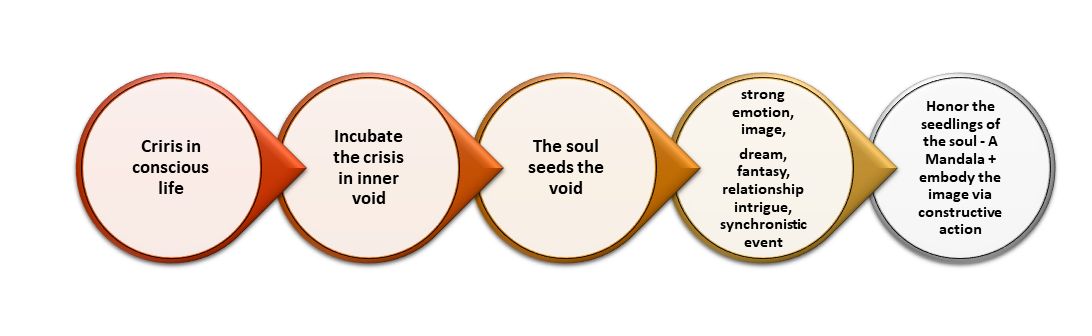
The external world has so many needs and demands, I must ensure my internal world has nourishment to thrive, so I make a positive contribution to the collective. This calls for creating and honoring the sacred void we must create in our life. This sacred void may be gestated by blocking out the turbulence of the storms in our consciousness, the crisis de jour. While it is necessary to respond to this crisis in the moment, we would do a much better job of it when we descend into an inner void. This void is the temenos, the alchemic vessel of the soul where the soul has space to manifest, to unfold, to seed the potential for a response consistent to the crisis of the moment, the wisdom of our depths and the call of the future, aligned with the bigger scheme of the Universe. Such a stirring of the soul may manifest as a dream, an image, a fantasy, a synchronistic event, an intrigue with a new relationship, a medical or psychiatric symptom; but it is always accompanied by a strong affect – a feeling of something numinous stirring within us. The seed of the soul must be nurtured by introspection, self-reflection, journaling, and honoring the manifestation of the soul via some form of embodiment, enactment, action and drawing the mandala of new possibilities. One may draw this Mandala, dance it, live it, but honor it we must if we are to create an ongoing dialogue with our soul and the archetypes and myths that guide us.
When Carl Jung was depressed after feeling abandoned by his mentor Sigmund Freud, he had strong and confusing feelings of loss, abandonment and crisis of identity as a therapist. He made room for creating a void, a temenos for self-reflection. He called this his Confrontation with the Unconscious(Jung & Jaffé, 1963). He documented his feelings and amplified them via dialogue with the images provoked by these feelings. Later, he would draw these dialogues as Mandalas. He made his most significant contribution and discoveries in Analytical Psychology – the school of Depth Psychology during this encounter with his inner void, pain and the response of his soul to these feelings. This whole process is documented in his Red Book. (Jung & Shamdasani, 2009). The method he used for this inner dialogue is called active imagination. (Jung, 1969)
Points to Ponder:
- How do you maintain balance between internal and external demands?
- How does your creative force show itself to you?
- What do you do to listen deeply to your soulful needs?
- How do you meet those needs?
- When dealing with crisis in your life, do you react or take time to reflect?
- Are you able to create a void to incubate the affect and the impact of the crisis on your inner life?
- Do you make room to receive the seeds of the soul responding to the crisis?
- Does your soul speak via a dream, fantasy, synchronistic event, new relationship intrigue or a medical or psychiatric symptom?
- How does this soul manifestation feel? How strong is the feeling?
- How do you respond to this image or manifestation of soul’s response?
- Do you reflect on it, draw it, journal it, amplify it via a myth or a fairy tale?
- Do you act on the new insight via constructive action towards self-improvement and to serve your community?
Jung, C. G., & Shamdasani, S. (2012). The red book = Liber novus A Reader’s Edition (1st ed.). New York: W.W. Norton & Co.
Jung, C. G. (1969). The structure and dynamics of the psyche, Volume 8 (2d — ed. Vol. 20). Princeton, N.J.: Princeton University Press, pages 67-91
Jung, C. G., & Jaffé, A. (1963). Memories, dreams, reflections. London: Collins and Routledge & Kegan Paul.
Jung, C. G., & Shamdasani, S. (2009). The red book = Liber novus (1st ed.). New York: W.W. Norton & Co.
Ashok Bedi, M.D., Jungian Psychoanalyst,
www.pathtothesoul.com , www.tulawellnessllc.com
Robert BJ Jakala PH.D., Jungian Psychotherapist
In a storm, the safest place is in the eye of the storm. My colleague BJ and I will share our daily reflections on this centering process from an Analytical perspective, sharing from the repertoire of our personal and professional experience. BJ is a psychologist and a photographer and will pick an image of the day that catches him in this collective crisis. I will amplify it from a Jungian Analytical perspective. We hope that this may offer you a baby step on the path to your own unique response to this chaos.
© Ashok Bedi, M.D. and Robert BJ Jakala, PH. D