June 19, 2021
The fish in dreams occasionally signifies the unborn child, because the child before its birth lives in the water like a fish; similarly, when the sun sinks into the sea, it becomes child and fish at once. The fish is therefore a symbol of renewal and rebirth. (Jung 1956, 198 para 290)

I am curious about my dream life and its interface with my memory. How much of what happens in a dream is amplified or diminished due to my memory or the filters that are consciously/unconsciously activated? This image is an example of the intersection of memory and the reality of a moment. There are discrepancies between what I remember and what I created with the camera.
The day I took this photograph, I sat on a bench about ten feet from the koi. I remember stillness of the fish and its wonderful orange and yellow colors. My memory holds the image of the koi in clear water. I do not remember the reflection of green of green foliage from the other side of the pond, I do not remember the patches of bubbles floating on the surface either. I remember more depth in the water, and the rocks at the bottom. The photo is so different than what I recall of the experience of sitting with the fish.
The quote above relates to the image and the dynamic of an unborn child. I see the parallel to the content (fish) as Jung describes, but also to any dream. There is life to be noticed in dreams. The dream has a life while I sleep, and a different life as I bring it to the light of day—just as a fetus becomes an infant. As the dream emerges out of dreamland and brought to my waking world, the dream content may shift from the influences of the waking life. I see myself as a midwife to the dream as I hold it in memory. My job is to support the life it is bringing to my waking world and listen to its soulful message.
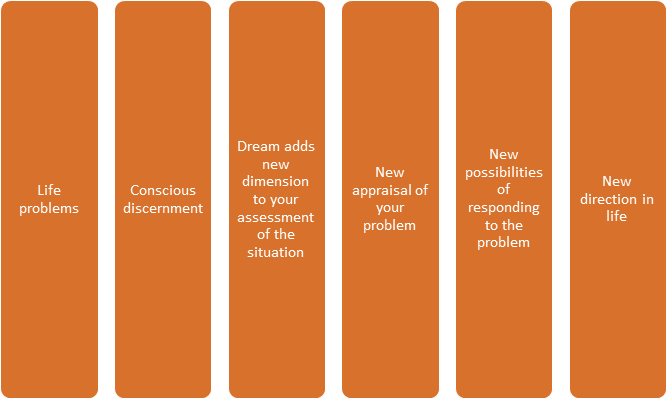
Thus, there is a fascinating relationship between the dream and the total reality. The reality includes the conscious perception by our senses of the image our ego creates of the reality in the moment, but the dreams captures the rest of the story: this includes the area of potential cognitive field that our ego did not focus upon, the unconscious aspects, potentials and possibilities related to the situation, the archetypal memory invoked by the situation and the teleological instructions in why we chose to focus on a given field of perception.
For example, during one of our study tours to India, 2 of the participants in our group focused on the profusion of garbage on the streets. One participant saw this as an indication of exploding materialism, population explosion, environmental impact etc. This individual was depressed by the spectacle ridden with pessimism and despair – caught in the maternal, protective archetype. Another individual saw this as an indication of the populace moving towards growth, wealth and started to research what company deals with waste management in India so that she could buy some stock in that company as an investment opportunity. She as caught in the archetype of Heroine- initiative, hopefulness and enterprise. Both saw the rest of the story in a very different way based on their previous life history, their archetypal repertoire and teleological possibilities. Both participants have valuable contribution to make. One had a maternal response, protective of the people, environment and future, the other had a heroic response, attending to growth, prosperity and possibilities.
Our conscious perceptions give us a screenshot of the part of reality accessible to our cognitive apparatus. The dreams give us a glimpse into the compensatory, archetypal memory pointing the way to new possibilities. Jung and other Jungians have explored these fascinating aspects of our dream in rich analytical literature. (Bosnak 1998, Jung 1974, 2010, Mattoon 1978, Whitmont 1992)
Points to Ponder:
- What value do dreams have in your life?
- How do you enliven or diminish your dream content?
- What similarities does your dream life have to waking life? What differences?
- Do you have a favorite or most memorable dream?
- What new information to your dreams offer about your problems and concerns?
- Does this additional information offered by your dreams open up new ways of perceiving and responding to your concerns?
- Do your dreams offer a path forward in making some life choices?
Bosnak, Robert. 1998. A Little Course in Dreams. Later Printing edition ed. USA: Shambhala;.
Jung, C. G. 1956. Symbols of transformation; an analysis of the prelude to a case of schizophrenia. Vol. 5, Bollingen series ; 20. New York: Pantheon Books.
Jung, C. G. 1974. Dreams. Published by MJF Books, N.Y. ed. USA: Princeton University Press.
Jung, C. G. 2010. Children’s Dreams: Notes from the Seminar Given in 1936-1940 (Jung Seminars). USA: Princeton University Press (September 12, 2010).
Mattoon, Mary Ann. 1978. Understanding Dreams. Spring Editions 1984 ed. Woodstock, Connecticut: Spring Publications.
Whitmont, E. C. Perera Slyvia Brinton. 1992. Dreams, A Portal to the Source. 1 ed. London and New York: Routledge;.
Ashok Bedi, M.D., Jungian Psychoanalyst,
www.pathtothesoul.com , www.tulawellnessllc.com
Robert BJ Jakala PH.D., Jungian Psychotherapist
In a storm, the safest place is in the eye of the storm. My colleague BJ and I will share our daily reflections on this centering process from an Analytical perspective, sharing from the repertoire of our personal and professional experience. BJ is a psychologist and a photographer and will pick an image of the day that catches him in this collective crisis. I will amplify it from a Jungian Analytical perspective. We hope that this may offer you a baby step on the path to your own unique response to this chaos.
© Ashok Bedi, M.D. and Robert BJ Jakala, PH. D