October 30, 2021
The complexes, then, are partial or fragmentary personalities. When we speak of the ego-complex, we naturally assume that is has a consciousness, because the relationship of the various contents to the center, in other words to the ego, is call consciousness. But we also have a grouping of contents about a center, a sort of nucleus, in other complexes. So, we may ask the question: Do complexes have a consciousness of their own? (Jung, 1976, p. 73 para 153)
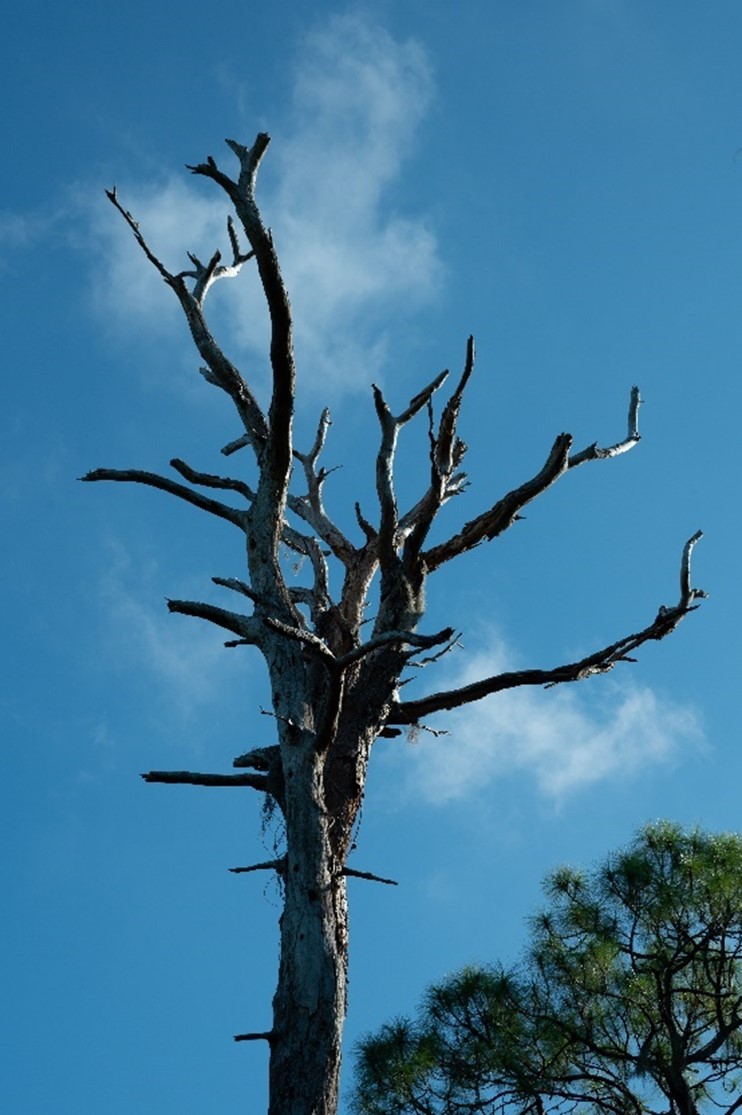
While hiking in a nature preserve this tree drew my attention. It was as though it said, “Hey, look over here. There is more to this landscape than greenery and flowers.” As I turn my head, nature’s life sculpture, captures my attention. This preverbal moment stops me in my tracts. I feel the presence of core majestic life. The bare structure is stark and no longer hidden by minor limbs and leaves of history. I see the various limbs, the trunk, and make note of the directions of their growth. When I reflect on each of the limbs, I appreciate how each has a particular view of life. Each connects to the trunk but extends outward in its own way. As each limb grew in its own direction and destination, it was held by the trunk and fed by the unseen root system below.
There are two trees in view. Each of them presents a natural state of being. Each attractive in their own way. One looks back and sees what it has been, the other looks forward to what lies ahead. They model a quality of reflection and of anticipation. Both qualities add dimension to life.
When I consider the Jung quote above, I think about the various aspects of who I am and the different directions those aspects have taken and/or are taking. The thing that helps me most are to know my complexes, stay balanced, and be grounded/nourished so I may live out my existence as fully as possible.
Each hang-up or complex we have is a problem to our consciousness and an opportunity to engage the treasures of the unconscious. There is no redundancy in the economy of the psyche. Every problem has a spiritual purpose. It is roadmap to the deeper consciousness of our potentials and our promise, if we have the courage to endure it, suffer it and lean into it to explore it. It is the Adriane’s thread which we must follow to find the way back to our deepest potentials.
Adriane’s thread is based on the myth of finding your way out of the labyrinth.
Theseus volunteered to join the band of youths who were to be sacrificed. He traveled to Crete, and as soon as he arrived Ariadne, King Minos’ daughter, fell in love with him. She offered to help him conquer the labyrinth and kill the minotaur if he would marry her and take her away from Crete. He agreed. Ariadne gave him a ball of red thread, and Theseus unrolled it as he penetrated the labyrinth, which allowed him to find his way back out. He found the minotaur deep in the recesses of the labyrinth, killed it with his sword, and followed the thread back to the entrance.
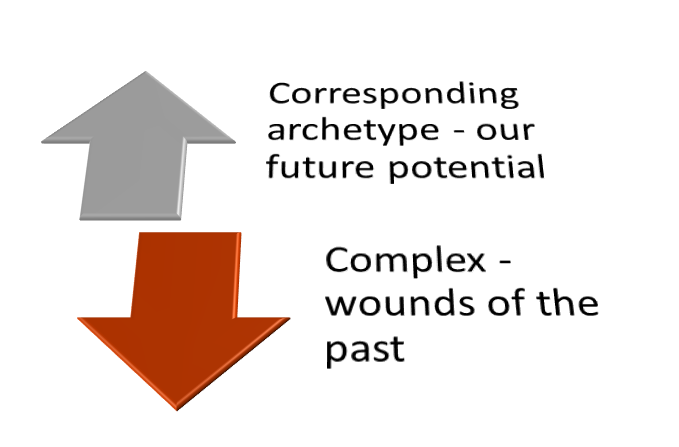
If one has a mother complex in which the man experiences his mother as disengaged, then he would feel abandoned. This wound may create a mother complex where this individual may perceive significant women in his life as emotionally distant, be it spouse, friend, boss or teacher. Then he may have a dream in which he may dream of the Holy Virgin. This is the activation of the healing Great Mother archetype to compensate for the distant mother complex. This Great Mother archetype may then be experienced in a new relationship or a mentor thus opening up new ways of relating to women who offer the possibility of meaningful attachment, thus healing the negative mother archetype and enriching the relational matrix with vital and vibrant relationships with soulful women as friends, mentor and a lover.
Each complex opens up the door to new archetypal possibilities. They are a twin phenomenon. Our image has two trees: one tree is the complex, the barren tree that points to the wounds of the past that precipitated the complex and the lush tree is the archetype which points to the new possibilities or relatedness beyond the wounds of the past. Both are essential pieces of our inner work. They work at tandem to heal the past the grow into our future.
Points to Ponder:
- Name the different aspects of your life and the point of view they have.
- How do they guide you or do you guide them?
- How do you know when to look forward and when to reflect?
- Does your history nourish or prevent growth?
- What dialogue to you imagine between the two trees?
- What is your experience of the barren tree in your life?
- What complexes do you carry from the wounds of your past?
- Do you avoid engaging your complexes or lean into them to understand them and their origins in your life story?
- What is your perception of life outside the zone of your complexes?
- As you work through your complexes, do you have dreams or images that compensate for your complexes with alternative healing image and possibilities?
- Do you follow the Adrian’s thread of these images to new potentials?
- What is your experience of these new possibilities?
Jung, C. G. (1976). The symbolic life : miscellaneous writings (Vol. 18). Princeton University Press.
Ashok Bedi, M.D., Jungian Psychoanalyst,
www.pathtothesoul.com , www.tulawellnessllc.com
Robert BJ Jakala PH.D., Jungian Psychotherapist
In a storm, the safest place is in the eye of the storm. My colleague BJ and I will share our daily reflections on this centering process from an Analytical perspective, sharing from the repertoire of our personal and professional experience. BJ is a psychologist and a photographer and will pick an image of the day that catches him in this collective crisis. I will amplify it from a Jungian Analytical perspective. We hope that this may offer you a baby step on the path to your own unique response to this chaos.
© Ashok Bedi, M.D. and Robert BJ Jakala, PH. D