May 14, 2021
Theoretically, no limits can be set to the field of consciousness since it is capable of indefinite extension. Empirically, however, it always finds its limit when it comes up against the unknown. This consists of everything we do not know, which, therefore, is not related to the ego as the center of the field of consciousness. The unknown falls into two groups of objects: those which are outside and can be experienced by the senses, and those which are inside and are experienced immediately. The first group comprises the unknown in the out world; the second the unknown in the inner world. We call this latter territory the unconscious. (Jung & Hull, 1959/1968, p. 3 para 2)
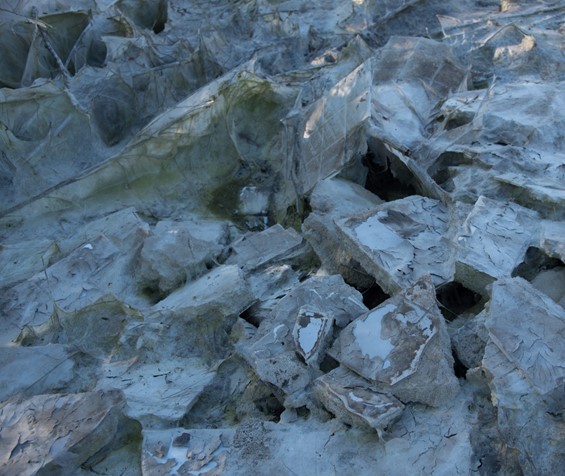
The image gives the option of revealing something conscious or unconscious. I can use the waking world as a source of the familiar for recognition or I can use the unfamiliar to trigger my imagination as to what the image is in the outside world. Another option is to have it be something of my inner world, something in my unconscious.
When I reach into the outer world for familiarity, I might soothe my need to know, but I cut off my imagination. So sometimes having an answer brings the process to an end, much like finding the meaning in a dream which is then set down.
Another option is to take the image inside into the unconscious via sensation. By doing so, I acknowledge a deeper response, a physiological reaction to it. Essentially, my brain would be in its most primary response before activating higher levels of acknowledgement. It would inform me with heart and breathing rate, touch, smell, taste, and visual experience of the image. Then I could begin to explore what the image is from an inside perspective, and possible to another dimension.
In the fast pace of today’s world, I often stay in the conscious response to what is happening by comparing it to what I know or which with I am familiar. I must create time for an alternative practice through meditation, prayer, yoga, tai chi, mindfulness, etc. I remain limited if I remain comfortable with the known. Encountering the unknown gives me opportunity to learn and stretch into who I will become.
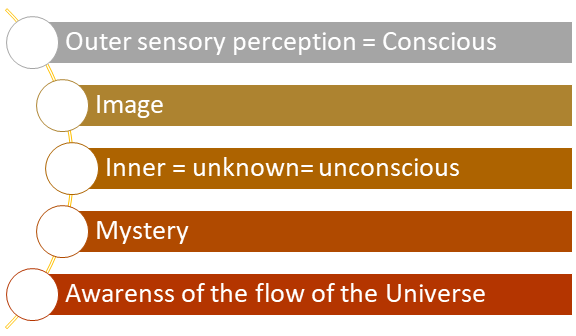
In the present culture of the 15 minutes of fame, the breaking news, the short attention span, the news of the minute, the fast-moving twitter feed, the Instagram, we live in a transient consciousness, disconnected from our depths, divorced from the timeless, the atemporal, the transcendent reality and mystery that pervades human consciousness and is the authentic pacemaker of lives, events, flow of our emergence and the teleological thrust of the soul and the call of the Spirit.
More disconnected we are from this deeper flow of the universe; more it calls our attention. When we disconnect from it as individuals, it sends us a memo via our dreams, fantasy, synchronistic events, accidents, complexes, medical and psychiatric symptoms and relationship tangles. When we are truant from it as a culture, it calls us for realignment with the flow via collective catastrophes, climate changes, political upheavals, pandemics, strife, revolutions and war. We only have 2 choices: listen to the call of the depths, as individuals and as a society or to attend to it in crisis, emergencies, catastrophes and apocalyptic manifestations.
Choice is ours to make!
When we are connected to the source, we feel it in our bones. It is experienced as a sense of balance, alignment, peace and bliss – Ananda. This manifests when we look, not just with the two eyes but by our third eye: the inner eye – the Antarchaksu. Each one of us is blessed by this inner eye – use it!
Points to Ponder:
- How did you respond to the opening quote from Jung?
- What is your response to the image?
- How do you respond to outer unknown?
- How does your inner unknown reveal itself?
- Do you attend to the memos from your soul or ignore them until there is a crisis?
- What system do you have to tune into and receive the memos from the unconscious?
- Do you feel that as a society, we pay attention to the call of the universe or we kick the ball downfield?
- In matters of discernment, are you content with looking at the surface or do you take a deep dive into the rest of the story?
- What framework have you established to get to the rest of the story in personal and community matters?
Jung, C. G., & Hull, R. F. C. (1959/1968). Aion : researches into the phenomenology of the self (2nd ed. Vol. 9 Part II ). Princeton, N.J.: Princeton University Press.
Jung, C. G. (1964). Civilization in transition (Vol. 10). New York: Pantheon Books.
Ashok Bedi, M.D., Jungian Psychoanalyst, www.pathtothesoul.com , www.tulawellnessllc.com
Robert BJ Jakala PH.D., Jungian Psychotherapist
In a storm, the safest place is in the eye of the storm. My colleague BJ and I will share our daily reflections on this centering process from an Analytical perspective, sharing from the repertoire of our personal and professional experience. BJ is a psychologist and a photographer and will pick an image of the day that catches him in this collective crisis. I will amplify it from a Jungian Analytical perspective. We hope that this may offer you a baby step on the path to your own unique response to this chaos.
© Ashok Bedi, M.D. and Robert BJ Jakala, PH. D