November 6th, 2021
Also, the meaning of the dream, or our interpretation of it, is largely dependent on the intentions of the interpreter, on what he expects the meaning to be or requires it to do. In eliciting the meaning he will involuntarily be guided by certain presuppositions, and it depends very much on the scrupulousness and honesty of the investigator whether he gains something by his interpretations or perhaps only becomes still more deeply entangled in his mistakes. So far as presuppositions are concerned, we may take it as certain that the dream is not an idle invention of the conscious mind but an involuntary, natural phenomenon, even though it should prove true that dreams are in some way distorted by becoming conscious. Anyway, this distortion occurs so quickly and automatically that it is barely perceptible. It is therefore safe to assume that it is an integral part of the dream-function. (Jung, 1964, p. 151 para 320)
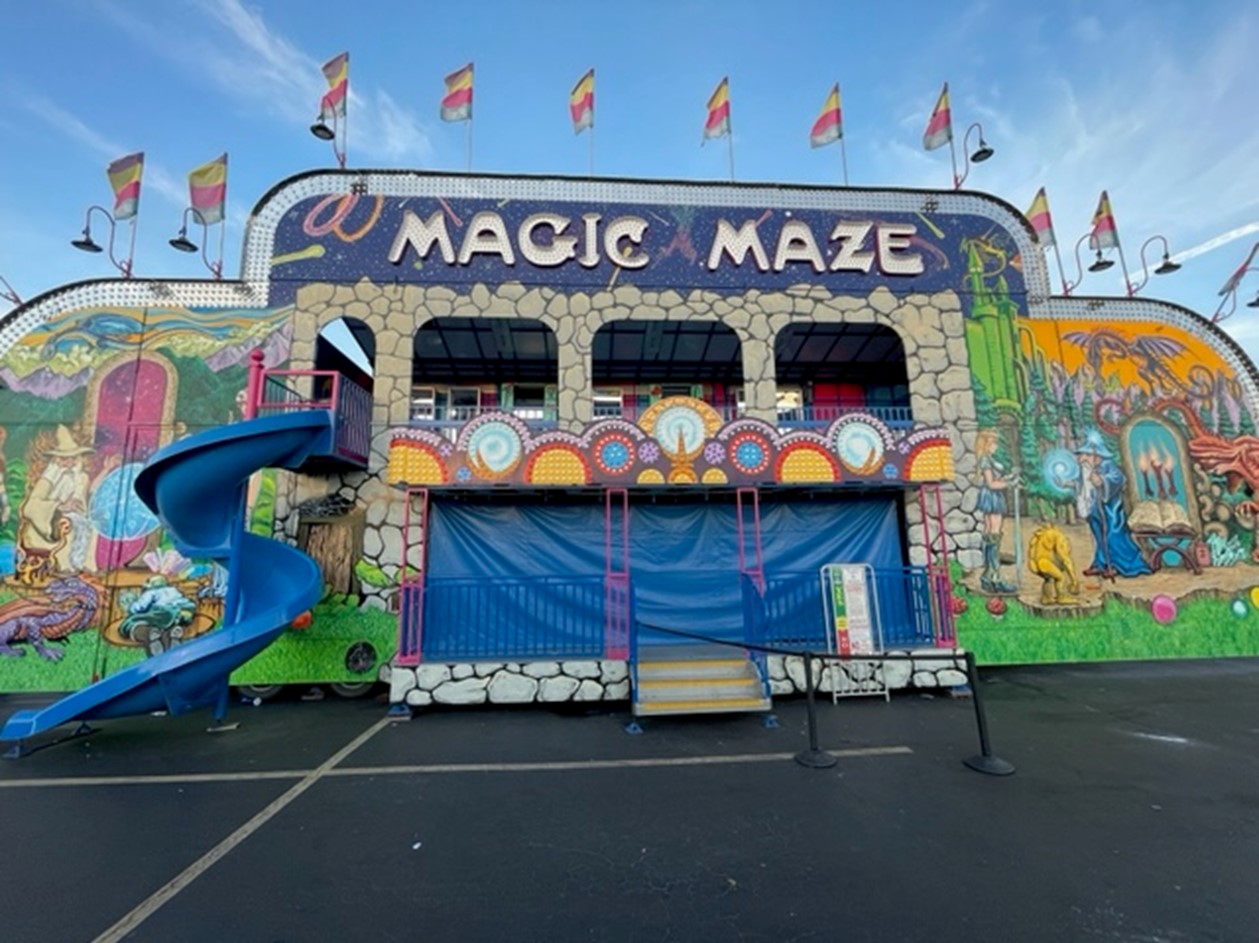
This carnival fun house lets me see myself in a great variety of magnifications and distortions. The task is to figure out how to move forward while confronted with distortion mirrors, darkness, turn-abouts, plexiglass panels the let me see ahead, but block the movement forward. It is an out of the ordinary world experience that is like my dream life. When I exit, I struggle to remember all the elements I just encountered.
While inside this carnival event, it is enjoyable for me to watch and listen to other reactions to the same stimulus. Some are laughing, some are puzzled, and some are frustrated and scared. It shows me how differently the external is interpreted depending on the perception of the viewer.
The Magic Maze feels parallel to what happens when I step into and out of a dream. I know I was in another world with familiar and unknown elements that are distorted and straight forward. The difference, of course, is the maze of the dream is created by personal and collective elements, elements that lead me to meaning and understanding of who I am, who I have been, and who I will become.
At the end, the dream is a map to our higher potential (Jung, 1974; E. C. P. S. B. Whitmont, 1992). It is giving us a magic maze that gives us a lots of information about our navigation skills in our journey into the unconscious where each one of us uses a unique GPS to forge ahead. Some of us get caught in our cognitive distortions (Burns, 2008), others are snared by their complexes, yet others get seduced the illusory promise of their redundant personal myth rather than embrace their emerging myth, e.g., from Prince to the King archetype; yet others stay in their comfort bubble of their superior typological function rather than brave to venture into their inferior function – the thinking type fearful to engage their feelings or the intuitive type avoidant of sensate attention to details etc. (Franz & Hillman, 1986). An accurate decoding of a dream calls for avoiding these traps so that its core guidance may be crystallized and implemented.
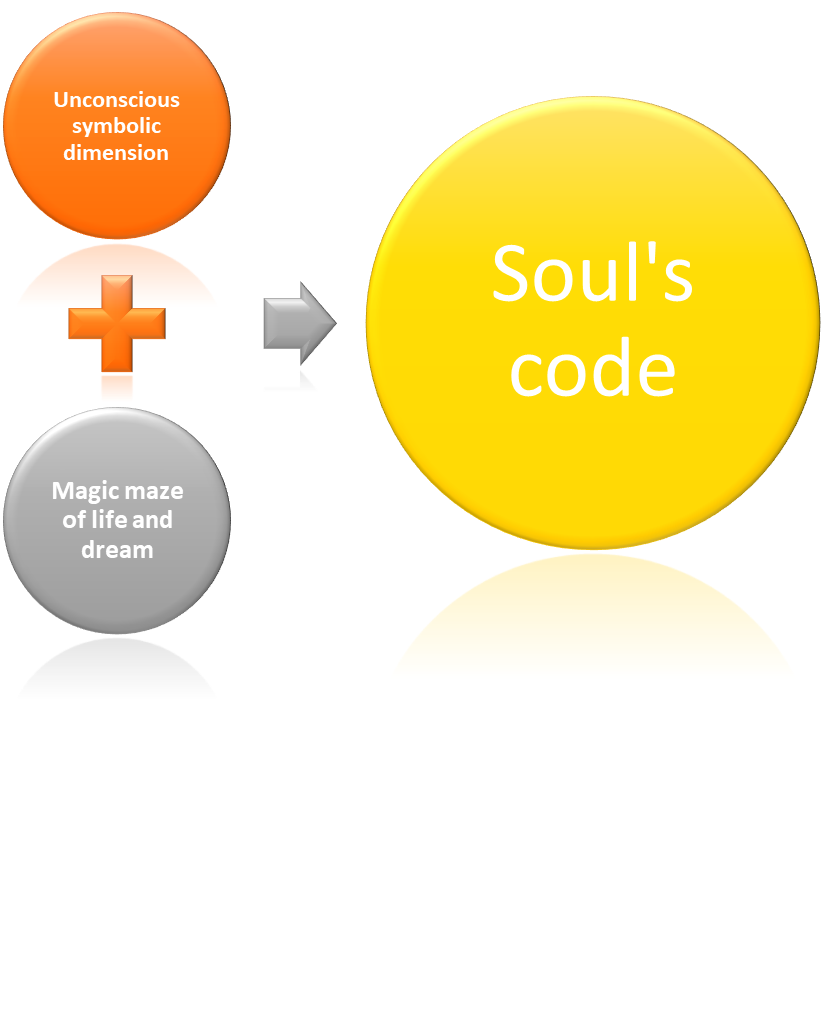
When all is said and done, it is my personal and clinical experience that life itself is a dream of our Soul. It communicates its instructions to use as we are caught in the magic maze of our outer life, oblivious of our deeper Self. We are caught in distorted mirrors, illusive detours, dead end turns and the like created by the same distortions as in our dream work that I have outlined above. To pursue the path to the soul, we must differentiate these distortions from the Soul’s code and courageously sacrifice our stasis in the comfort bubble and venture out courageously into the new territory indicated by the dream symbol or life’s synchronicities and symbols around us. How to recognize these symbols is a subject for a different discussion,(E. C. Whitmont & C.G. Jung Foundation for Analytical Psychology., 1969) but for this communication, suffice it to say that if we become curious and respectful of the symbolic, deeper dimension of our life embedded in our personal and collective unconscious, then the magic maze of dream or life opens us the true magic of this lifetime- a treasure hard to attain but the real purpose of incarnation as You! If you do not attend to your Soul Program then you must wander in many lifetimes before you return as You again, perhaps more informed about your spiritual depths and your celestial origins. The Hindus define these distortions and detours as the Maya and the Soul program is our Dharma or spiritual purpose. I have explored these concepts in an earlier publication.(Bedi, 2000)
Points to Ponder:
-
How do your dreams inform you?
-
What is your response to the unknown elements of your dreams?
-
Are there recurring themes? How do you engage them?
-
Do you engage the understanding of your dream from a concrete or symbolic lens?
-
Do you navigate your life focused on our conscious goals and aspirations or are you open to a deeper and different direction if thus instructed by your unconscious?
-
Do you look at life and dreams via the lens of your cognitive distortions or sort through to a rational lens?
-
Do you stay stuck in your hang-ups and complexes, or do you look outside of your box?
-
Do you stay in the comfort zone of your typological mandala e.g., thinking versus feeling or intuition versus sensate?
-
Are you embedded in your present personal myth like hero, victim, martyr etc. or are you open to your emerging myth, king, leader, mentor etc.?
-
Do you perceive as an individual limited to what you experience as Me in this moment or do you consider yourself as a part of some deeper reality embedded in your I?
-
Do you feel you are a drop, or do you experience yourself as a drop in the ocean?
-
Are you able to tune into the mystery and the wisdom of the ocean of the collective unconscious and the timeless flow of the eternity or do you prefer to stay only in the here and now?
-
What is your paradigm or GPS to tune into the timeless wisdom of the universe, that is if you believe in it!?
Bedi, A. (2000). Path to the soul. York Beach, ME: S. Weiser.
Burns, D. D. (2008). Feeling Good: The New Mood Therapy (Reprint edition ed.). USA: Harper.
Franz, M.-L. v., & Hillman, J. (1986). Lectures on Jung’s typology. Dallas, Tex.: Spring Publications.
Jung, C. G. (1964). Civilization in transition (Vol. 10). New York: Pantheon Books.
Jung, C. G. (1974). Dreams (Published by MJF Books, N.Y. ed.). USA: Princeton University Press.
Whitmont, E. C., & C.G. Jung Foundation for Analytical Psychology. (1969). The symbolic quest : basic concepts of analytical psychology. New York: Published by Putnam for the C. G. Jung Foundation for Analytical Psychology.
Whitmont, E. C. P. S. B. (1992). Dreams, A Portal to the Source (1 ed.). London and New York: Routledge;.
Ashok Bedi, M.D., Jungian Psychoanalyst,
www.pathtothesoul.com , www.tulawellnessllc.com
Robert BJ Jakala PH.D., Jungian Psychotherapist
In a storm, the safest place is in the eye of the storm. My colleague BJ and I will share our daily reflections on this centering process from an Analytical perspective, sharing from the repertoire of our personal and professional experience. BJ is a psychologist and a photographer and will pick an image of the day that catches him in this collective crisis. I will amplify it from a Jungian Analytical perspective. We hope that this may offer you a baby step on the path to your own unique response to this chaos.
© Ashok Bedi, M.D. and Robert BJ Jakala, PH. D