May 29, 2021
The aim of individuation is nothing less than to divest the self of the false wrappings of the persona on the one hand, and of the suggestive power of primordial images on the other.(Jung, 1953, p. 174 para 269)
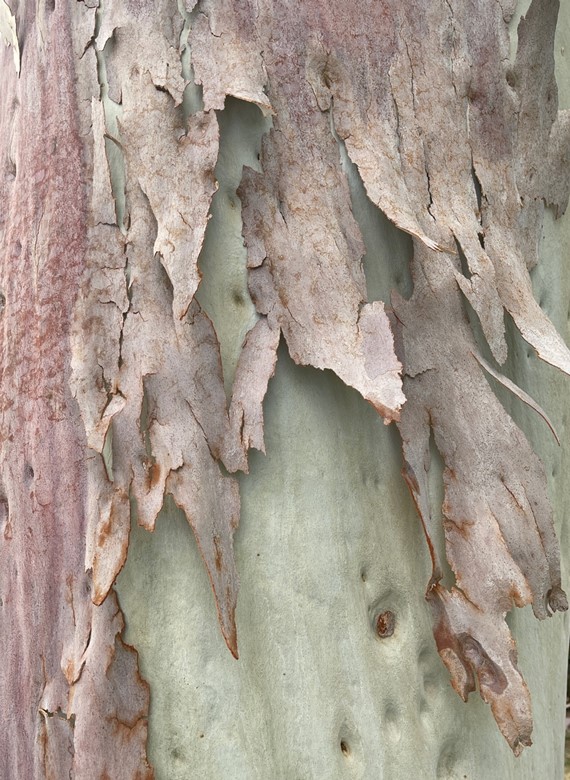
The eucalyptus tree sheds its outer bark routinely. It shows me it is important to remove what the world has seen to reveal the deeper layers. Other deciduous trees shed their leaves in the fall, but for the most part their trunk grows thicker. Their bark is more defined with age, essentially keeping the same patterns.
Individuation is like a eucalyptus tree’s growth cycle rather than the deciduous or evergreen trees. The individuation process reveals more of the real self while letting go of an outer layer I have attached to or one the world imposed on me. Every now and then, I must decide when the season is right for me to shed outer layers—layers that no longer serve my deeper or higher self.
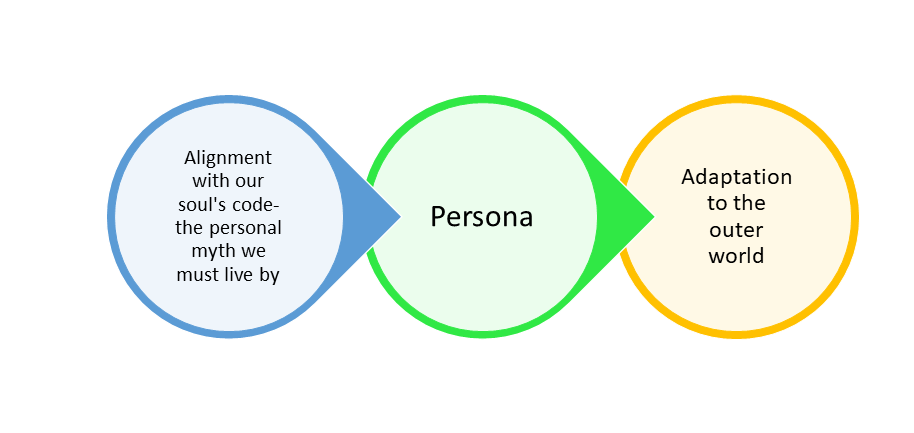
Persona is the skin of the personality and the emissary of the Soul. It has the same genetic and cellular structure as our unique body and our soul’s code. It has the dual task of maintaining harmony with our body while presenting an optimal face to the outer world to maintain peace with it while protecting us from the dark and harmful aspects of the outer world. It is a complicated task to balance inner harmony and outer defense. It is a task worthy of the gods’ guidance and skillful navigation. It is the domain of the divine Trickster – Hermes and Krishna its Eastern analogue to manage this boundary between the inner and the outer worlds. It helps us best sync with the personal myth we live by.
In our early life, we are guided by the personal myth of the child who must depend on the parents while striving for autonomy. In young adulthood, we are under the auspices of the myth of the warrior/hero who must establish their personal domain in the academic, professional and work domains. In adulthood, we are guided by the lover archetype where we must maintain the hero stance but yield to the call of the heart and mutuality in a safe relationship. Still later, in our late adulthood, we must claim the archetype of the leader in our area of calling. At the dusk of life, we move from the hero/lover/leader zone to the Kenosis: letting go of the fragile outer attachments and Samsara tangles and yield to the call of the soul- detachment is the key here, Pratyahara – a disposition of dispossession (as my friend Fr. Joe Pereira calls it) – to move to the archetype of the Anchorite, Mentor, guide to others. Each of these developmental stages calls for shedding the previous persona to make room for a new mask for the next stage. This is the art of Individuation – a crucial facet of our soul work and is essentially a spiritual task to attend to the successive callings of a well lived, soul informed, “Right Life”. In such an individual, the Persona is the mask that offers the best channel for our Soul to speak through the mask. That is the meaning of the word Persona: Per=via the mask and sonar=the tube that connects the actors mask to their mouth within the mask. So, a mask while consistent with the actor’s role still permits the soul of the performer to speak its’ soul’s truth. Such is the mystery of the mask, construct it carefully, not just to adapt to the outer world but always synced with the soul’s code. Our inner work guides us in the spiritual assignment. May the gods be with you!
Points to Ponder:
- What parts of your persona have you shed in the past?
- How did you decide it was time to show the world more of who you really are?
- What inner layer is pushing to reveal itself?
- What informs you to change?
- What life stage are you at? Child, young adult, adult, leader, mentor?
- Is your Persona consistent with your personal myth?
- Are you in one life stage with a Persona of another season of your life? E.g., a Mentor who is stuck in a Persona of a Warrior or Lover?
- What is preventing you from shedding the Persona of an earlier life stage? Is there some unfinished business of your narrative that you must get closure to?
- What will it take in terms of inner work and outer life to conclude this unfinished business of your story to make room for your new beginnings?
- How do you plan to engage the new Persona consistent with your Soul stage? Are there echoes of unfinished myths that you need to let go – Kenosis – to make room for a new myth to guide your life journey?
- With successive shedding of the redundant Personas, does more of your Soul stem or less of it manifest in your consciousness?
- Whatever the adaptive outer demands on your Persona, are you able to let your authentic soul voice speak via your mask? Is the tail wagging the dog or the dog wagging the tail? Does your Soul fall in with your Persona or your Soul speaks in spite of and through your mask?
Jung, C. G. (1953). Two essays on analytical psychology (Vol. 7). Princeton New Jersey Bollingen Series/Princeton University Press.
Ashok Bedi, M.D., Jungian Psychoanalyst, www.pathtothesoul.com , www.tulawellnessllc.com
Robert BJ Jakala PH.D., Jungian Psychotherapist
In a storm, the safest place is in the eye of the storm. My colleague BJ and I will share our daily reflections on this centering process from an Analytical perspective, sharing from the repertoire of our personal and professional experience. BJ is a psychologist and a photographer and will pick an image of the day that catches him in this collective crisis. I will amplify it from a Jungian Analytical perspective. We hope that this may offer you a baby step on the path to your own unique response to this chaos.
© Ashok Bedi, M.D. and Robert BJ Jakala, PH. D