October 15, 2021
We cannot visualize another world ruled by quite other laws, the reason being that we live in a specific world which has helped to shape our minds and establish our basic psychic conditions. We are strictly limited by our innate structure and therefore bound by our whole being and thinking to this world of ours. Mythic man, to be sure, demands a “going beyond all that,” but scientific man cannot permit this. To the intellect, all my mythologizing is futile speculation. To the emotions, however, it is a healing and valid activity; it gives existence a glamour which we would not like to do without. Nor is there any good reason why we should. (Jung, 1961, pp. 300-301)
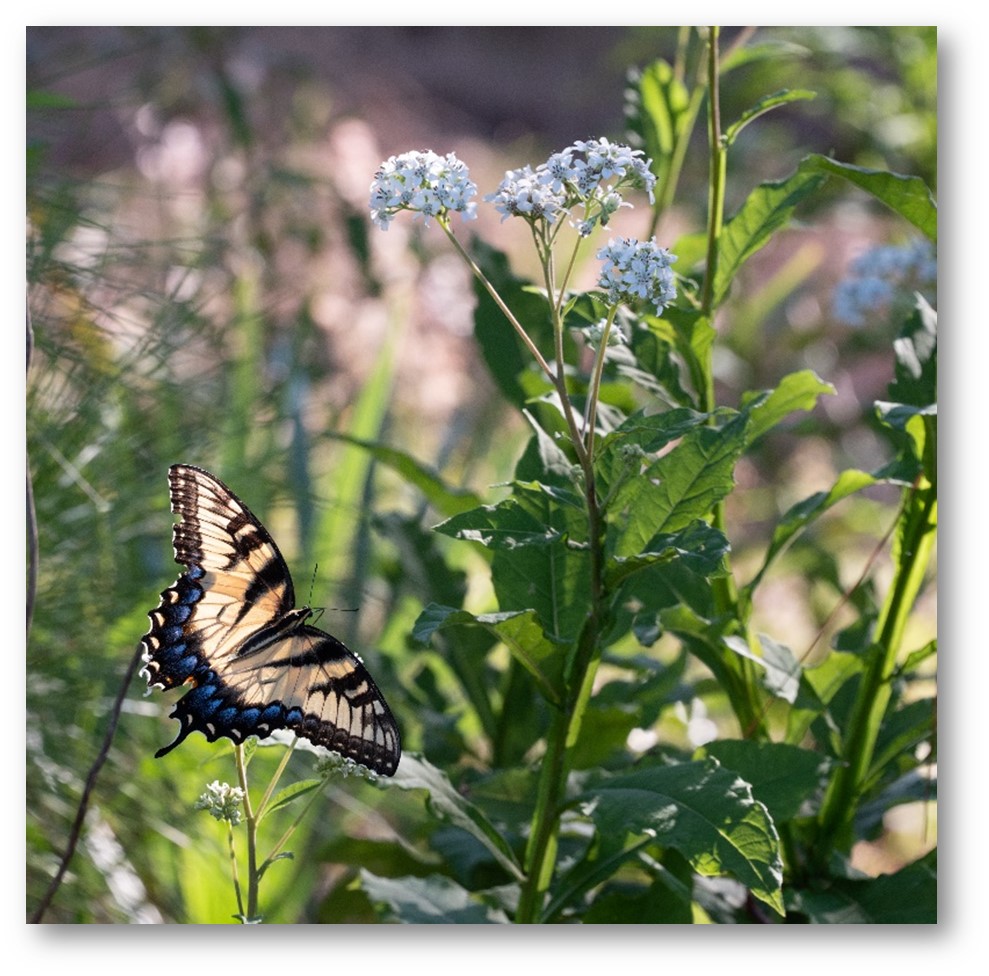
I can make a scientific explanation of the image, which according to the Jung quote, brings satisfaction to my intellect. There is value in being familiar with the objects in view and understanding what is happening. The result brings ease and quiets my mind like solving a math problem. Somehow, I find the knowledge settling.
There is another way to engage the image that invites my imagination—through story. What is the story of image? I can start in this moment of flight and flowers where the sunlight is enlivening all the colors. I imagine myself as each of the various elements. What is the experience of the butterfly and the flowers? Is the story/myth about the movement of the butterfly or the stillness of the flowers? What is the history of each? What is the future of each? When I engage and amplify the image with my imagination, my emotional life is enlivened. My intellect is stimulated with possibility rather than settled and quiet.
Story can explain the scientific or activate the imagination of our path or our wishes. I learn about my world view and who I am by bringing myth (known or imagined) to an image. The image can be a mirror of my inner world more than a window to the outside world.
Each one of us are many Selves and live-in multiple Universes. We are mythic, complex, multiverse beings, oblivious of our real story. When we get a glimpse of the rest of the story, we become informed, whole, vital and live out our true destiny in this lifetime. Sometimes, it takes many lives to learn the rest of our story. How do we engage this mystery? The quest for this mystery of our many selves in many lives has been the central theme of many Eastern traditions including Hinduism and Buddhism. That will be an interesting topic for another time, but for today, let us peek into this mystery through a little crack into your consciousness via a lens of incredulity.
It is through the cracks in our consciousness, in our default view of ourselves, others and world around us that we get to peek into the deeper Self. These cracks are windows into our eternal Self. In my clinical experience, these cracks manifest as life problems, crisis, trauma, loss. At other times, they manifest as dreams, fantasies, creative process like drawing, singing, dancing, journaling. In clinical practice, I see these in my patients’ medical and psychiatric problems, addictions, relationship problems, accidents and synchronicities. In others, it manifests as personality problems, complexes, neurosis and psychosis. These are all windows into our deeper, celestial core. With contemplative practices, psychological guidance, reflective attitude, spiritual roadmap and a soul guide-Guru-analyst, one may be able to descend into the Soul and ascend into the higher realms of the Spirit.

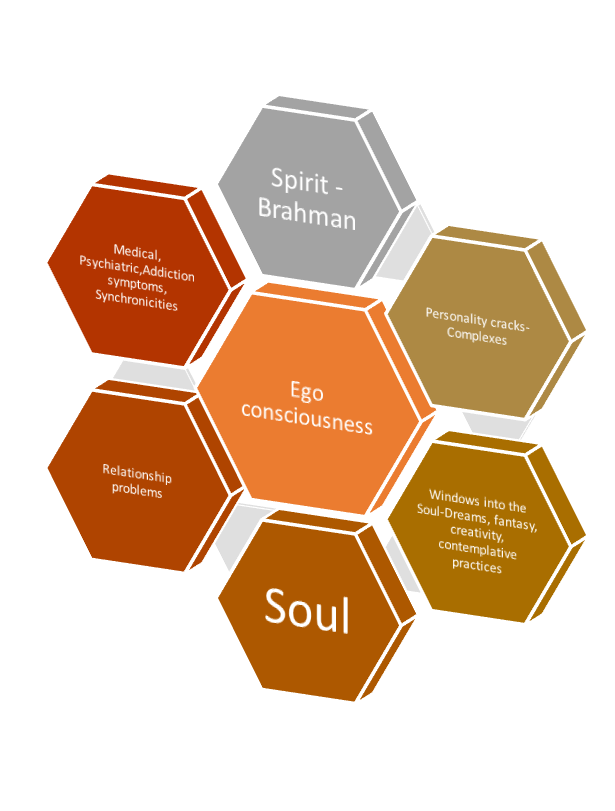
This brief blog is not the place to unravel this exciting, mysterious process of Transcendence, but we merely want to make our readers curious about their immense inner potential and the great good they can do to cultivate these personal potentials and put these in service of their families, communities and for higher good. They can become a precious cog in the cosmic wheel of the world Soul – The Unus Mundus – the Collective Consciousness – the Brahman Matrix. You can become IT – following the great formulae: the Mahavakyas in the Upanishad ,”TAT SVAM ASI – That Art Thou”. (Radhakrishnan, 2019)
Chandogya Upanishad 6.8.7 of the Sama Veda)
Points to Ponder:
- Do you engage the image scientifically or mythically?
- What view of life do you generally take?
- What part of the image do you identify with?
- Just as the flower was a seed and the butterfly a caterpillar, each of them is more than the moment. How does your history influence the present moment?
- Do you perceive you as the present you or the historical you?
- Do you assess you as your past and your present or an image of your “Emergence” in the future you?
- How do you imagine a future you?
- Do you see yourself through your traditional function, e.g. feeling, or thinking, intuition or sensate (details driven) or through all four lens of perception?
- Do you engage the world with your default attitude, e.g., introvert or extrovert, or do you engage it appropriate to the context, i.e., there is time to engage and time to reflect?
- Do you make life decisions based on your usual way of acting or do you have a reflective, discerning space where you pray, meditate, consult the scriptures, engage your dreams, pay attention to synchronicities, create or draw an image, play, consult your advisors, before you act?
- Do you have a sacred space for silence, solitude, studio-time, self-reflection, journaling, drawing, walking, listening to music, exercising, fasting, praying before you crystallize your response to life’s crisis, traumas and turns?
- Do you have “GO TO” scriptures, soul-guides, system for your discernment process?
- Do you see yourself as “What you see is what you are” or do you get an occasional glimpse of the rest of your mystery?
- Do you see yourself as a temporal being or as a slice of eternity manifest only in part in this form, in this life, in this universe?
- Are you curious about the many incarnations of you in different time, in different space, and in a different universe?
- What is your fantasy of these other YOUs?
- How would you live out these other lives if you had a choice?
- Can you live out some of these reflections of you in this life?
Jung, C. G. (1961). Memories, Dreams, Reflections (R. a. C. Winston, Trans. April 1989 ed.). New York: Vintage Books.
Radhakrishnan, S.-E. (2019). The Principal Upanishads (S. Radhakrishnan Ed. 32nd impression – 2019 ed.). India: Indus / Harper Collins India; New edition (January 1, 1994), page 458.
Ashok Bedi, M.D., Jungian Psychoanalyst,
www.pathtothesoul.com , www.tulawellnessllc.com
Robert BJ Jakala PH.D., Jungian Psychotherapist
In a storm, the safest place is in the eye of the storm. My colleague BJ and I will share our daily reflections on this centering process from an Analytical perspective, sharing from the repertoire of our personal and professional experience. BJ is a psychologist and a photographer and will pick an image of the day that catches him in this collective crisis. I will amplify it from a Jungian Analytical perspective. We hope that this may offer you a baby step on the path to your own unique response to this chaos.
© Ashok Bedi, M.D. and Robert BJ Jakala, PH. D