September 18, 2021
The man, therefore, who, driven by his daimon, steps beyond the limits of the intermediary stage, truly enters the “untrodden, untreadable regions, where there are no charted ways, and no shelter spreads a protecting roof over his head. There are no precepts to guide him when he encounters an unforeseen situation—for example, a conflict of duties. (Carl G. Jung, 1961, p. 344)

I remember how excited I was to go to the playgrounds as a child. They were an exciting place with various structures to engage a blend of physical strength, imagination, and gravity. For the most part, it was about my ability on the piece of equipment rather than a competition against anyone else. It was a challenge, especially when it was something I had not tried before. Then of course, once I was familiar, it was about climbing faster, jumping higher, etc. It was practice of making choices, gaining new skills, as well as natural growth and development as it occurs in childhood.
Today, my “playground” is so different in a structural way. It requires making choices, but they are from a variety of ideas, responsibilities, dreams, personal and spiritual growth endeavors. When I let my dreams lead me, I always seem to be invited to be more than my ego recognizes or identifies with. There is often much more experience to engage in, more horizontal as well as vertical.
When presented with a challenge, I do better when I take an optimistic view with curiosity and action. I must ask myself what success looks like and how will I know I’m successful? I ground myself in trust that more will be revealed as the journey proceeds, rather than thinking I must know all the answers before action. I take more of an organic approach rather than a clear strategic one.
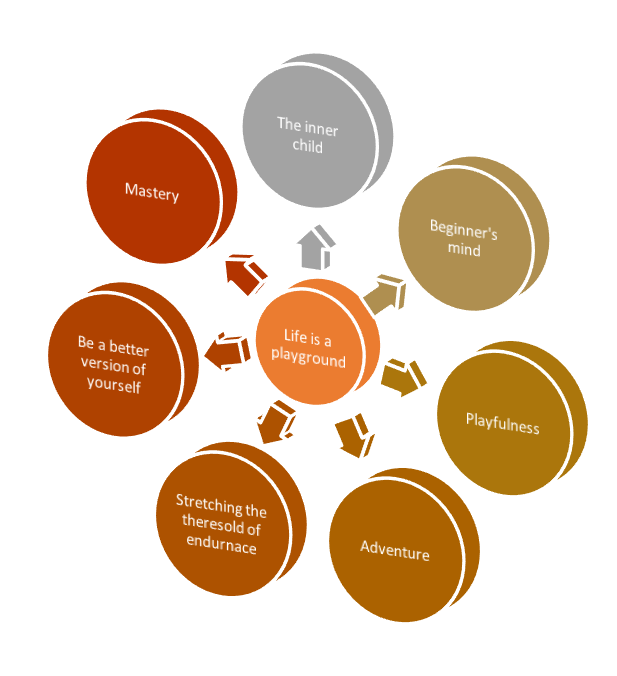
The image above has many choices, and they cannot be all done at once. Make the first choice, then proceed.
Life is a playground. We engage it optimally from the vantage point of the “Inner Child” in us. This perspective factors in a challenge to negotiate new twists and turns, a beginner’s mind, playfulness, adventure, stretching beyond our previous threshold of endurance, claiming a better version of ourselves, and a sense of mastery. However, the most significant dimension of this analogy is it a play; life is a playground of our soul – we are living out an inner script on the stage of life. It is not the outer situation but the inner paradigm that guides our process.
As Shakespeare famously said,
All the world’s a stage,
And all the men and women merely players.
They have their exits and their entrances,
And one man in his time plays many parts,
His acts being seven ages. At first, the infant,
Mewling and puking in the nurse’s arms.
Then the whining schoolboy, with his satchel
And shining morning face, creeping like snail
Unwillingly to school. And then the lover,
Sighing like furnace, with a woeful ballad
Made to his mistress’ eyebrow. Then a soldier,
Full of strange oaths and bearded like the pard,
Jealous in honor, sudden and quick in quarrel,
Seeking the bubble reputation
Even in the cannon’s mouth. And then the justice,
In fair round belly with good capon lined,
With eyes severe and beard of formal cut,
Full of wise saws and modern instances;
And so he plays his part. The sixth age shifts
Into the lean and slippered pantaloon,
With spectacles on nose and pouch on side.
His youthful hose, well saved, a world too wide
For his shrunk shank, and his big manly voice,
Turning again toward childish treble, pipes
And whistles in his sound. Last scene of all,
That ends this strange eventful history,
Is second childishness and mere oblivion,
Sans teeth, sans eyes, sans taste, sans everything.
https://en.wikipedia.org/wiki/All_the_world%27s_a_stage
This soul attitude towards the drama on the playground of life calls for two dimensions: aligning oneself with the soul’s program and remembering that play is just a play and maintain core detachment to the drama of life. Since we are just actors, we must defer to the director of the play – the director being our soul which is aligned with spiritual flow of life and the universe. We are but a small spoke in the cosmic cogwheel. We stay aligned with the soul’s program by staying tuned to our inner whispers via attention to dreams, synchronicities, imagination and contemplation. Jung offers his view on this symbolic life in his well known essay on the subject.(C. G. Jung, 1976)
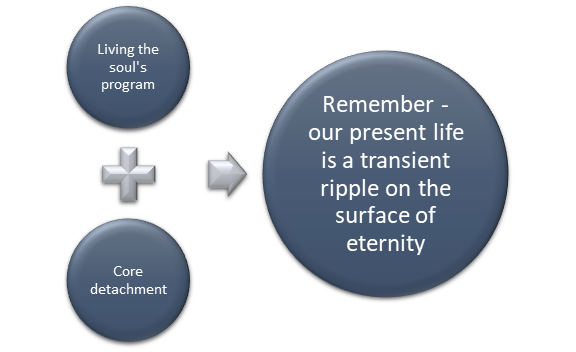
When we are at such crossroads in the forks of life, we must not do just what is expedient but rather make a more informed choice aligned with our deeper program. Then, we are part of the flow of life and its purpose in the plan of the universe, the flow of Brahman, the Unus Mundus – coniunctio with the world soul. The Christian tradition encapsulates this beautifully in the Lord’s prayer;
Matthew 6:9-13
New International Version
9 “This, then, is how you should pray:
“‘Our Father in heaven,
hallowed be your name,
10 your kingdom come,
your will be done,
on earth as it is in heaven.
11 Give us today our daily bread.
12 And forgive us our debts,
as we also have forgiven our debtors.
13 And lead us not into temptation,
but deliver us from the evil one.
Points to Ponder
- How do you answer the call to be more than you are?
- How does that call show up in your life?
- When you have conflicting duties, how do you choose?
- What attitude do you adopt when dealing with new challenges and opportunities in life?
- Do you engage it with an attitude of childlike curiosity, without preconceived notions, with a sense of playfulness, adventure and mastery?
- Do you compete with others or focus on doing your personal best?
- At the forks in life, do you make expedient choices or consult your inner life?
- Do your life choices factor in your family, community and higher good?
- Do you see yourself traveling in a void of your current existence or see yourself as part of a bigger plan of the universe?
- Do you perceive a larger force guiding your life?
- What is your personal checklist to consult the program of your depths?
Jung, C. G. (1961). Memories, Dreams, Reflections (R. a. C. Winston, Trans. April 1989 ed.). New York: Vintage Books.
Jung, C. G. (1976). The symbolic life: miscellaneous writings, Volume 18 (Vol. 18). Princeton, N.J.: Princeton University Press, chapter 3.
Ashok Bedi, M.D., Jungian Psychoanalyst,
www.pathtothesoul.com , www.tulawellnessllc.com
Robert BJ Jakala PH.D., Jungian Psychotherapist
In a storm, the safest place is in the eye of the storm. My colleague BJ and I will share our daily reflections on this centering process from an Analytical perspective, sharing from the repertoire of our personal and professional experience. BJ is a psychologist and a photographer and will pick an image of the day that catches him in this collective crisis. I will amplify it from a Jungian Analytical perspective. We hope that this may offer you a baby step on the path to your own unique response to this chaos.
© Ashok Bedi, M.D. and Robert BJ Jakala, PH. D