June 12, 2021
Those who know my work may possibly profit by it; others perhaps will be impelled to look into my ideas. My life is what I have done, my scientific work: the one is inseparable from the other. The work is the expression of my inner development; for commitment to the contents of the unconscious forms the man and produces his transformations. (Jung, 1961, p. 222)
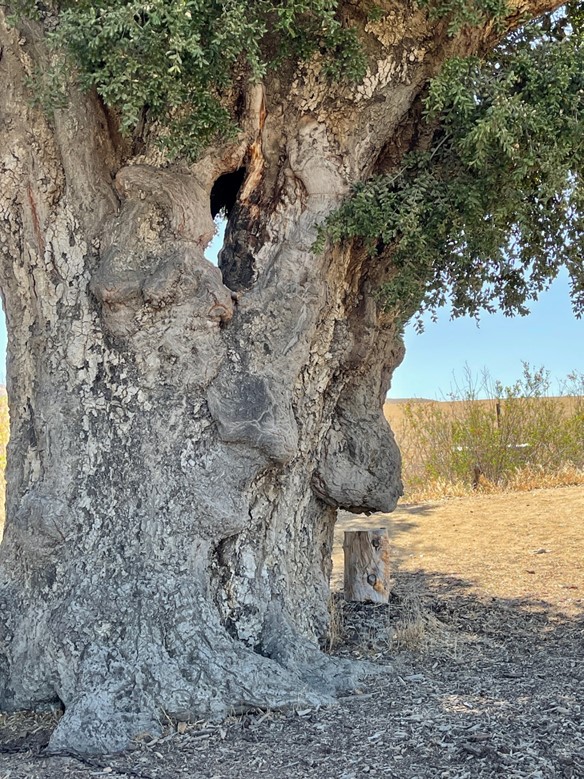
The California Live Oak Tree in Highland Springs, California, is over one thousand years old. As I stand before it, I feel still while feeling very much alive. I have a sense of insignificance as it towers in all directions. Life etched its way into the bark. Life left the impact of creation and destruction on the surface of this great tree. There are so many patterns, textures, and shades of gray that display the tree’s life work and what is has done. The tree stands as example of what the world above ground does. It is a harbor for some and a home for others, just like Jung’s writings.
Much like the work of Jung, the tree has life that is not seen, yet vital to its survival and growth, the work underground. It is the root system and its interaction with the soil and moisture that provides access to the nutrients the leaves need for photosynthesis. Each of us have an internal life, physical, mental, and spiritual, that informs us to be creative in our growth and healing.
The environment of this past year feels different than most. The impact of the pandemic, social injustice, and political changes has left their mark on our country as well as each of us personally. The challenge concerns how each of us expresses our inner development and how that influences the external world.
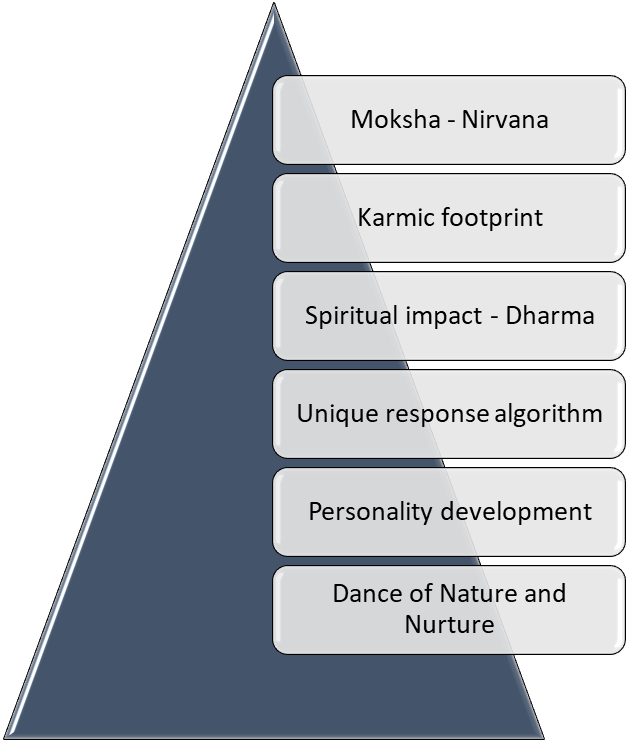
Each one of us lives in multiple dimensions. The most immediate dimension is the alchemic dance between our inner personality and our environment. This is our soil. This includes our biological endowment, our social milieu and our personality structure. Psychology clusters these as the interaction of nature and nurture. This unique personality then responds to life and its challenges. This response paradigm is our signature personality. This forms the response dimension. The Vedanta system(Parthasarathy, 2015) proposes broad categories of the mineral, vegetable, animal, human and higher personalities, with a complex sub-classification, useful to physicians and mentors in ancient times. How each one of us then impacts the world around us becomes yet another dimension of our existence.
The Purva Mimamsa calls this our Dharmic dimension of life. When we cultivate our personal best potentials, it constitutes our Sva Dharma or Self-transformation. Then we may put these cultivated potentials in service of our family – Ashrama Dharma, our community – Varana Dharma and to explore the Spiritual dimension – Reta Dharma (Bedi, 2000). Lower souls leave a negative karmic footprint in this lifetime, while the evolved souls leave this world a better place than they found it. Highest souls complete their spiritual maturation over many lifetimes of reincarnation and merge with the Spirit, like a river merging into the ocean. This is called Nirvana in Buddhism and Moksha in Hinduism. The Karmic cycle in now complete. This is the tree of our life! Perhaps, each one of us has a tree personality: you may ponder what kind of a tree you would call yourself? Few of us may reach the status of an Oak tree or a Banyan tree in this lifetime.
Points to Ponder:
- What do you experience as you look at the image of the tree?
- How does knowing its age impact you?
- What is the work of your life?
- How has the outer world circumstances influenced the work of your life?
- What grounds you when the outer world gets difficult?
- What impact has your life had on others?
- What do you want to be known for and what are you doing to show it to the world?
- How would you construct the tree narrative of your life?
- What went into your personality developments in terms of nature and nurture?
- What is your response paradigm to life’s challenges?
- Do you have a reptilian response or a reflective and soulful response to crisis and trauma?
- What is the Spiritual impact of your life on your self-development, your family, your community and higher purpose?
- Do you feel you may leave a negative Karmic footprint in this life, or you hope to leave this world a tad better than you found it?
- In the current pandemic and social turbulence in our world, do you feel that you have responded in a survival mode or service mode?
Bedi, A. (2000). Path to the soul. York Beach, ME: S. Weiser.
Jung, C. G. (1961). Memories, Dreams, Reflections (R. a. C. Winston, Trans. April 1989 ed.). New York: Vintage Books.
Parthasarathy, A. (2015). Vedanta treatise : The eternities (17th ed.). London: Vedanta Institute.
Ashok Bedi, M.D., Jungian Psychoanalyst,
Robert BJ Jakala PH.D., Jungian Psychotherapist
In a storm, the safest place is in the eye of the storm. My colleague BJ and I will share our weekly reflections on this centering process from an Analytical perspective, sharing from the repertoire of our personal and professional experience. BJ is a psychologist and a photographer and will pick an image of the day that catches him in this collective crisis. I will amplify it from a Jungian Analytical perspective. We hope that this may offer you a baby step on the path to your own unique response to this chaos.
© Ashok Bedi, M.D. and Robert BJ Jakala, PH. D