May 22, 2021
We call the unconscious “nothing,” and yet it is a reality in potentia. The thought we shall think, the deed we shall do, even the fate we shall lament tomorrow, all like unconscious in our today. The unknown in us which the affect uncovers as always there and sooner or later would have presented itself to consciousness, Hence we must always reckon with the presence of things not yet discovered.(Jung, 1934/1954/1968, p. 279 para 498)
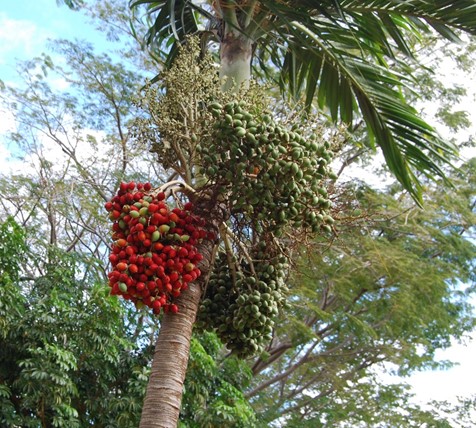
My eyes are drawn to the red colored seeds, the seeds most developed. In a short amount of time, they will fall onto the soil below. They will break open and take root in the earth. They will not be dependent on the parenting tree. They will have their own life in fertile soil.
There are also three other clusters of seeds, all in different stages of development. When conditions are right, they too will fully develop, turn red, and will fall to grow on their own.
The process reminds me of how countless items in the unconscious are released into consciousness. When the time is right, something is brought to my awareness by “dropping in” via dreams, symptoms, slips of the tongue, etc. It is up to me to provide fertile soil for it to open and take root. It is my opportunity to dialogue with it to understand what it is, what it needs, and how it informs me of who I am and how I can grow into my potential.
The most profound mystery of our unconscious is that it holds the seeds of all our potentials and the guidance and the psychic Materia to actualize these potentials. Jung called this the teleologic or the purposive function of the unconscious. It carries these potentials for individuals as well as the society as a whole. It further continually integrates the past as a piece in the jigsaw puzzle of the emergent order. Old structures continually become building blocks of the new structures. This is the process of evolution and individuation. We are continuously emerging as a better version of us if we engage the process. There is no limit – each one of us has infinite potential. We are only limited by the constriction in our imagination and trust deficit in the numinous dimension of the unconscious and its capacity for abundance for all. Here is a quote from the Isha Upanishad,
All this is full. All that is full.
From fullness, fullness comes.
When fullness is taken from fullness,
Fullness still remains.
(Eknath & Nagler, 1988), page 56
The process of claiming these treasures of the unconscious has been a subject matter of the great spiritual traditions. For instance, the six Sutras(Radhakrishnan & Moore, 1957) of Hinduism are a good template to map out the domain of the unconscious and to engage them for a higher purpose of achieving our personal best potentials and putting these potentials in service of our families, community and higher good. Many readers may be familiar with the most popular of these six systems – the Patanjali’s Yoga Sutra(Finger, 2018; Hartranft; Patañjali & Hartranft, 2003; Radhakrishnan & Moore, 1957; Satchidanada, 1978; White, 2014). In contemporary traditions, Jung’s Analytical psychology is a GPS par excellent to navigate the depths of our personal and collective unconscious and harvest the golden seeds of our infinite potentials, what the Hindus call the Golden Egg within, the “Hiranyagarbha.”
These golden seeds in our unconscious are constantly pinging our consciousness via dreams, fantasies, daydreams, accidents, synchronicities, complexes, medical and psychiatric symptoms, addictions, relationship problems and creative output. They manifest most vividly in artist, schizophrenics and children. The sophisticated pay heed to these pings and the shamans of these pings – the artist, schizophrenic and a child with their beginner’s mind and a new and fresh look at problems as potentials of our possibilities.
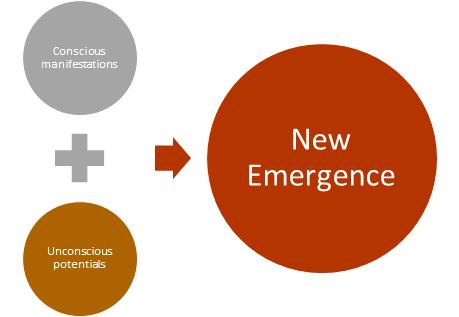
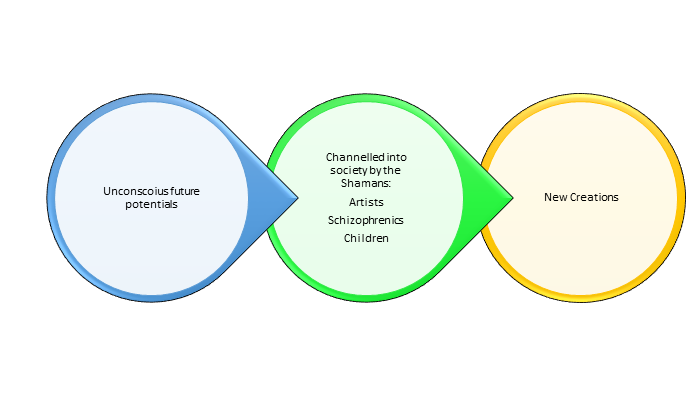
For those who are initiated into the mystery of the unconscious, they are able to proactively engage these golden seeds via contemplative practices, active imagination, meditation, mindfulness and Samyama practice outlined by Swami Vivekananda in his classic treatise on Raja Yoga.(Vivekananda & Ramakrishna-Vivekananda Center., 1982)
Points to Ponder:
- What has recently “dropped in” to your awareness?
- How do you engage something new?
- How do you treat the newly arrived seed?
-
Like the tree, how do you know when something is ready to be let go of?
-
What has been dormant that you can activate?
-
Do you honor your unconscious as a source of mystery and hidden potentials or a dark dungeon with hidden skeletons?
-
If you are intrigued by the potentials of your personal and collective unconscious, how do you tune into this mystery?
-
Do you feel that the world is a zero-sum game with winners and losers or do you feel that there is God given abundance and that every creature of universe is part of this win-win totality?
-
What is your personal paradigm to engage the realm of the unconscious? Do you pay attention to dreams, synchronistic events, symptoms as symbols, relationships as a hologram of your soul and your creative productions as an X-Ray of your emerging potentials?
Eknath, E., & Nagler, M. N. (1988). The Upanishads. London: Arkana.
Finger, A. N., Wendy. (2018). Tantra of the Yoga Sutra – Essential Wisdom for Living with Awareness and Grace. Boulder, Colorado, USA: Shambala Boulder.
Hartranft, C. The Yoga-Sûtra of Patañjali
Sanskrit-English Translation & Glossary. In (pp. 86). Arlingon, MA, USA: Chip Hartranft.
Jung, C. G. (1934/1954/1968). The archetypes and the collective unconscious (2d ed. Vol. 9). Princeton, N.J.: Princeton University Press.
Patañjali, & Hartranft, C. (2003). The Yoga-Sūtra of Patañjali : a new translation with commentary. Boston, Mass.: Shambhala Publications.
Radhakrishnan, S., & Moore, C. A. (1957). A source book in Indian philosophy. Princeton, NJ: Princeton University Press.
Satchidanada, S. S. (1978). The Yoga Sutra of Patanjali. Buckingham, Virginia: Integral Yoga Publications.
Vivekananda, & Ramakrishna-Vivekananda Center. (1982). Rāja-yoga (Rev. ed.). New York, N.Y.
Bourne End: Ramakrishna-Vivekananda Center ;
Ramakrishna Vedanta Centre.
White, D. G. (2014). The Yoga Sutra of Patanjali : a biography. Princeton: Princeton University Press.
Ashok Bedi, M.D., Jungian Psychoanalyst, www.pathtothesoul.com , www.tulawellnessllc.com
Robert BJ Jakala PH.D., Jungian Psychotherapist
In a storm, the safest place is in the eye of the storm. My colleague BJ and I will share our daily reflections on this centering process from an Analytical perspective, sharing from the repertoire of our personal and professional experience. BJ is a psychologist and a photographer and will pick an image of the day that catches him in this collective crisis. I will amplify it from a Jungian Analytical perspective. We hope that this may offer you a baby step on the path to your own unique response to this chaos.
© Ashok Bedi, M.D. and Robert BJ Jakala, PH. D