May 9, 2021
The positive aspect of the first type of complex, namely the overdevelopment of the maternal instinct, is identical with that well-known image of the mother which has been glorified in all ages and all tongues. This is the mother-love which is one of the most moving and unforgettable memories of our lives, the mysterious root of all growth and change; the love that meant homecoming, shelter, and the long silence from which everything begins and in which everything ends. (Jung, 1934/1954/1968, p. 92 para 172)

Mother’s Day is the celebration our mothers and the women in our lives that contributed to our becoming who we are. It is a recognition of the blend of what was given or held and what was received.
Our personal experience in life is also limited or expanded by the concept of mother told in fairy tales, legends, and myths, etc. We often compare our personal mother with the images of the perfect mother we imagine. For some, Mother’s Day is about admiring what was received, and for others it is longing for what did not occur.
Look at the image as a representation of mother. One post is the positive qualities of your mother and the other is her shortcomings. Where are you more attached? How do you anchor yourself to the land she governed? When and how do you remove the attachment for freedom of choice?
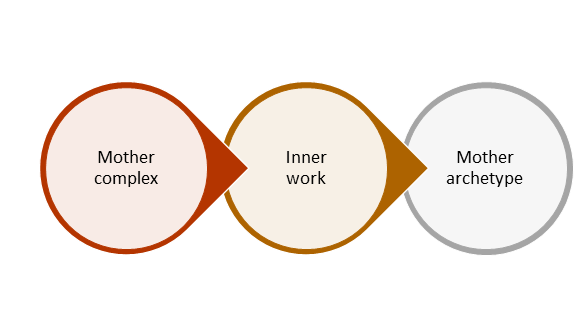
It is the task of a lifetime to differentiate between the experience of the personal mother from the mother complex. The mother complex is a blend of our real mother; light or dark with the fantasy of a mother experience we would have liked to have. This gap between the real mother and fantasy mother is the portal to the experience of the totality of the mother archetype. This gap is the roadway to the realm of the mothers that we return to from time to time to recharge, reboot and reconfigure our personality.
In Goethe’s Faust, when Faust was in crisis, his shadow mentor Mephistopheles advised him to return to the realm of the mothers – the archetypal ground of our psychic origins that we must return to from time to time to be gestated and rebirthed.
Mephistopheles: There is a way though.
I loathe to touch on more exalted riddle –
Goddesses sit enthroned in reverend loneliness,
Space is as naught about them, time is less.
The very mention of them is distress.
They are- the Mothers!
(Goethe von, 1998), pages 176-177, para 6210
At the end of his journey, Faust is redeemed form this Faustian bargain by the grace of the great mother at the conclusion of Goethe’s timeless classic
Gaze to meet the saving gaze,
Contrite all and tender,
For a blissful fate, your ways
Thankfully surrender.
May each noble mind be seen,
Eager for thy Service.
Holy Virgin, Mother, Queen,
Goddess, pour thy mercies!
(Goethe von, 1998), page 344, para 12100
We descend into this realm of the mothers, the healing waters of the unconscious via our dreams, complexes and inner work. We move beyond the mother complex to the wholeness of the mother archetype, our experience of the “Other” mothers we have been blessed to encounter in our life; our grandmothers, aunts, teachers, friends and the rich interface with the feminine universe, and at the end, the “Mother Within”, one capacity to forgive, love and nurture oneself.
As a society, as we hurl towards self-destruction through materialism, pandemics, racial strife, injustices, climate change, rape of the environment and the fundamental human values, it will be grace of the anima principle, feeling values and relatedness; hallmarks of the mother archetype that will redeem our civilization in distress as so well summarized in Goethe’s Faust.
Points to Ponder:
- What does Mother’s Day mean to you?
- How do you obtain the things your mother did not provide?
- What gifts or talents did your mother exemplify?
- How do you mother yourself or others?
- What mothering encounters you have had from your “other mothers”?
- How did these encounters with grandmothers, teachers, friends fill in the blanks of your mother experience?
- Do you feel that you use a masculine, material compass to guide your life or do you factor in the feelings, relationships, spiritual, mutual lens as a vector in your GPS?
Goethe von, J. W. (1998). Faust: A Tragedy (Norton Critical Editions) (Second Edition ed.). New York, London.: W. W. Norton & Company.
Jung, C. G. (1934/1954/1968). The archetypes and the collective unconscious (2d ed. Vol. 9). Princeton, N.J.: Princeton University Press.
Ashok Bedi, M.D., Jungian Psychoanalyst, www.pathtothesoul.com , www.tulawellnessllc.com
Robert BJ Jakala PH.D., Jungian Psychotherapist
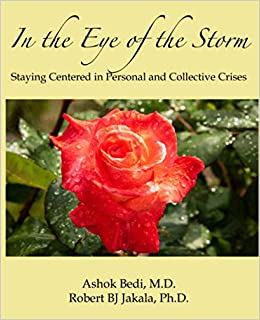
In a storm, the safest place is in the eye of the storm. My colleague BJ and I will share our daily reflections on this centering process from an Analytical perspective, sharing from the repertoire of our personal and professional experience. BJ is a psychologist and a photographer and will pick an image of the day that catches him in this collective crisis. I will amplify it from a Jungian Analytical perspective. We hope that this may offer you a baby step on the path to your own unique response to this chaos.
© Ashok Bedi, M.D. and Robert BJ Jakala, PH. D