June 25, 2021
It sounds very strange to modern ears that the inner man and his spiritual growth should be symbolized by metals….It seems that nature is out to prod man’s consciousness towards greater expansion and greater clarity, and for this reason continually exploits his greed for metals, especially the precious ones, and makes him seek them out and investigate their properties. (Jung 1967)
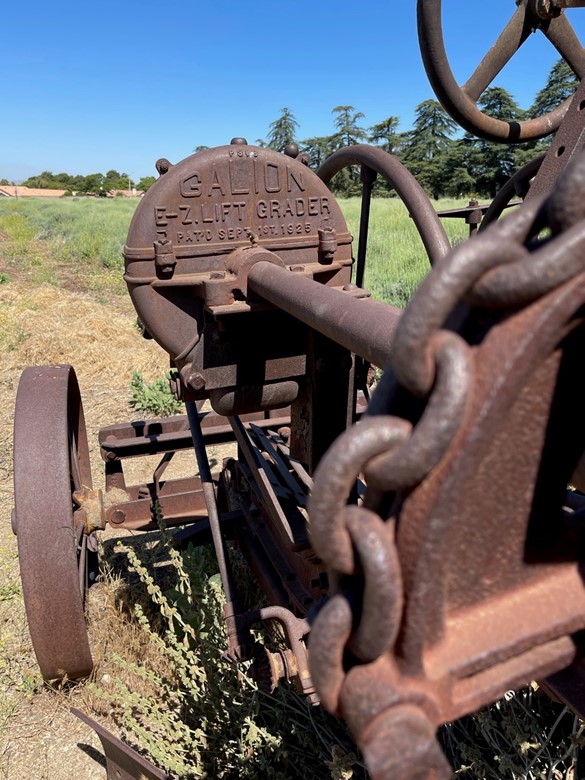
The grader is evidence of another time of life. Its iron frame gave farmers a way to shape the field on a large scale. It saved hundreds of hours of back-breaking work as a tractor pulled it across the terrain. The making of the gigantic “tool” required iron ore mining, transporting the ore to mills where it was changed to liquid, then it poured into molds, cooled, and assembled. The properties of iron, although not a precious metal as such as the quote suggests, are well known.
My inner life and spiritual work have a parallel process to the construction of the grader. I investigate my inner quarry to discover raw materials. Then with time and effort I shape an ingredient into a useful form that enhances my life. Let me use the idea of language to demonstrate this idea.
When I was a baby, I learned to make sounds that developed into language. Language became tool for me to identify the external world, mama, daddy, plane, car, etc. Eventually I put words together to construct sentences and have conversation about the outside world. Then with the help of adults, I learned the inner world of emotions and feelings. I had words to express my internal and experience. Words became a tool for me to navigate my way and expand my world.
Somehow, there are times when words are not sufficient. There are words that lead me away from the moment or do not satisfy the expression of an experience. Sometimes, I must set words aside, much like the grader that signifies an insufficient mechanism. In times when words are less than adequate, those ineffable moments, I find another method of expression or identification. I might use gesture, dance, music, art, sculpture, etc. The challenge is to find another way to communicate to myself or others. In those moments, my imagination and creativity would be helpful to engage the mystery of how to move beyond words.
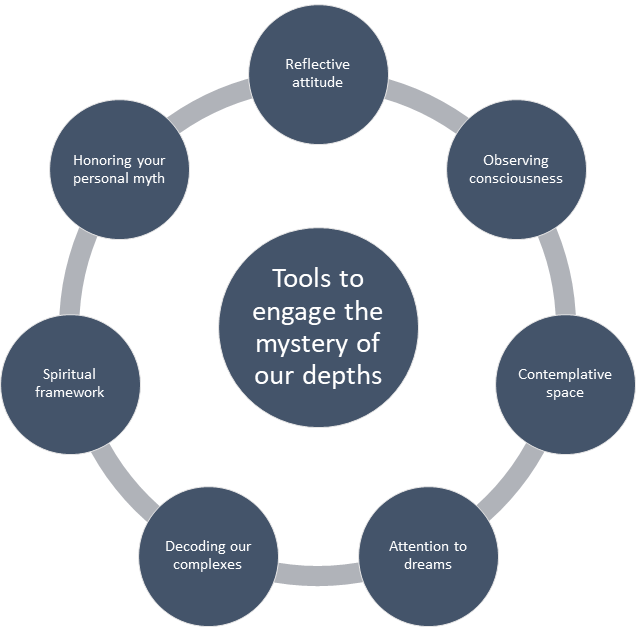
Our civilization manufactures tools to harvest the bounty of nature from the grader to the supercomputers, from hoe to spacecrafts, from a rattle to robots, from a magnifying lens to electron microscopes, and on and on. Similarly, each of us creates our own mental toolkit to engage the mystery of our psyche and seek its guidance in living a meaningful and purposeful life. This process of mentalization is an alchemic process. It transforms our personality into its higher essence, the lead aspect of our personality become golden. This leads to individuation, where we become the best versions of ourselves, what Nietzsche (Nietzsche and Hollingdale 1961) calls the Ubermensch aspect of our being.
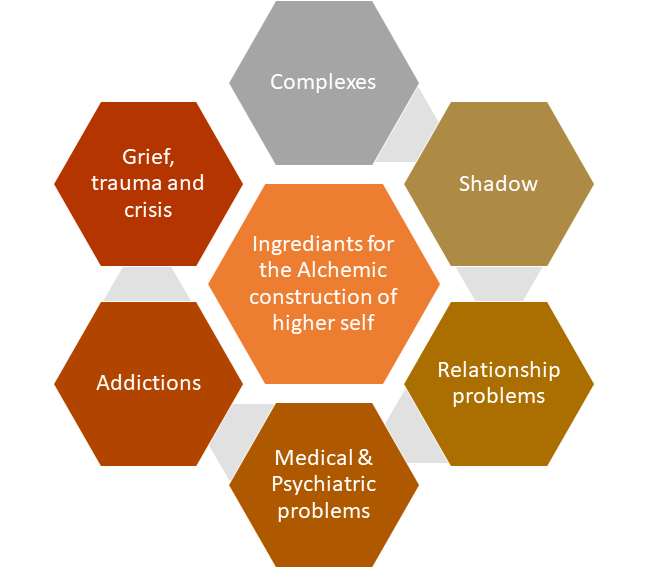
What are the raw materials we use for this mental constructions? These include our complexes, shadow, our broken parts, our relationship tangles and our problems.(Bedi 2000) It is through our brokenness that we break into our potentials. It calls for a reflective attitude, where we see our wounds as the portal to the source. Jung’s Analytical psychology offers one such roadmap to navigate this path. Every religious and spiritual tradition offers its own algorithm to navigate this mystery.
Points to Ponder:
- What tools help you in your inner life or spiritual growth?
- What approach do you use to approach the unknown?
- What have you learned in the pandemic that you want to keep doing in your life?
- Have you cultivated a reflective attitude?
- Do you consider your problems and brokenness as indicators of your soul’s prescriptions to engage your emergence?
- Have you created contemplative space and structures in your life?
- Do you have a spiritual framework to help you navigate your life journey?
- Do you pay attention to your dreams, symptoms and relationship issues and reflect on what they are trying to say to you?
- Do you have a glimpse into the higher version of you?
- What is your plan to get to that higher version of you?
- How would the Uber you deal with your present life and the pandemic?
Bedi, A. (2000). Path to the soul. York Beach, ME, S. Weiser.
Jung, C. G. (1967). Alchemical studies. Princeton, N.J., Princeton University Press.
Nietzsche, F. W. and R. J. Hollingdale (1961). Thus spoke Zarathustra : a book for everyone and no one. Harmondsworth, Penguin Books.
Ashok Bedi, M.D., Jungian Psychoanalyst,
www.pathtothesoul.com , www.tulawellnessllc.com
Robert BJ Jakala PH.D., Jungian Psychotherapist
In a storm, the safest place is in the eye of the storm. My colleague BJ and I will share our daily reflections on this centering process from an Analytical perspective, sharing from the repertoire of our personal and professional experience. BJ is a psychologist and a photographer and will pick an image of the day that catches him in this collective crisis. I will amplify it from a Jungian Analytical perspective. We hope that this may offer you a baby step on the path to your own unique response to this chaos.
© Ashok Bedi, M.D. and Robert BJ Jakala, PH. D