March 21st, 2021
Moreover, the self is felt empirically not as subject but as object, and this by reason of its unconscious component, which can only come to consciousness indirectly by way of projection. Because of its unconscious component the self is so far removed from the conscious mind that it can only be partially expressed by human figures; the other part of it has to be expressed by objective, abstract symbols. (Jung, 1934/1954/1968, p. 187 para 275)
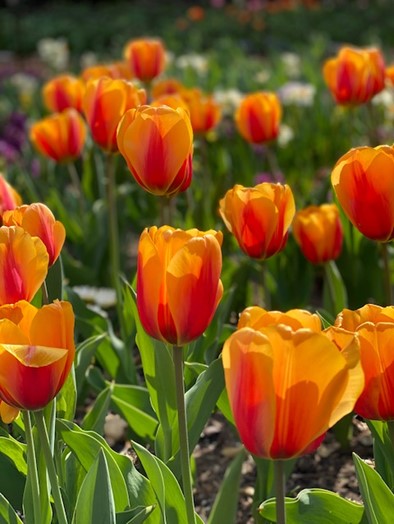
A field of tulips is a refreshing sight. The colors, tones, shapes, and textures resonate beauty, simplicity, and elegance. I find myself lost in so many projections of the spring equinox, its dramatic and subtle shift of one season to another.
As I read the quote of Jung above, it reminds me of the value of projection. It reveals a part of my wholeness I do not identify as myself. I will learn a deeper part of me, when I explore what the tulips represent individually and collectively. I can find meaning in the change of season and how do I view change internally or externally.
Depending on the threshold of individuation, an individual may experience Self as a subjective or objective phenomenon. Higher the individuation quotient, more subjective the Self is, lower the level of consciousness of the mystery of the psyche, the higher is the tendency for projection. In the intermediate states of consciousness and individuation, there is a dawning awareness that what intrigues us about the outer world of projections is a reflection of the subjective experience of the Self. The tell-tale sign that an object is a reflection of the Self is the capacity of the object to intrigue, mystify, awe, attract, repel, feel numinous or demonic and to create a high charge of emotional impact. More of these experiences, the higher our objective experience of the projected Self. So, to monitor these states of consciousness evoked by outer objects or situations is a useful indicator of our proximity to Self-experiences. It is worth paying attention to these states of consciousness as they are a treasure map to the incarnation of the Self, activated in our present life to guide us to the next steps of our emergence or teleological process.
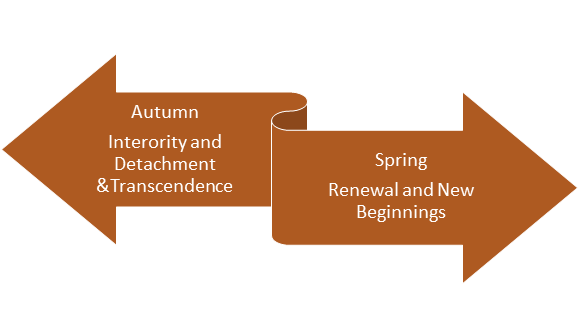
So, if a tulip field fascinates you, it is indicative that the Self of the observer is about to spring forth into a new blossom, a new beginning, a glorious chapter of life and renewal. Usually, this is preceded by the winter of one’s discontent or some dark night of the soul journey, about to end and thrust us into a new phase of life. It is symbolic of crucifixion to be followed by resurrection into our higher Self.
Some of us are intrigued by the autumn, when we are preparing for Pratyahara, detachment from the tangles of outer life, and ready to enter the interiority of winter, solitude and transcendence. In the Hindu tradition, this is preparatory stage of life for Vanaprastha, forest hood to be followed by Sanyasi or the Anchorite stage of life when an individual must prepare to merge with the divine at the end of days.
Points to Ponder:
- What does spring mean to you?
- How is an internal change of season revealed to you?
- What images, situations or environment intrigues you?
- Journal what thoughts, feelings, intuitions these images provoke in you?
- Do these objective images and situations provoke a numinous or demonic feelings?
- Are you able to relate the symbolic meaning of these images as a reflection of certain part of you or your possibilities?
- Do you have a roadmap to engage the symbolic instructions of the image?
- If images of spring intrigue you, do you have a sense of a new beginning and a plan to implement the process of renewal?
- If the images of autumn call you, do you see a way to interiority, detachment and claiming a deeper connection with the divine?
- As we retire our pandemic karma, do you have a plan of engaging your life – having assimilated the lessons of interiority, community and mutuality as the gifts of the lockdown?
- How will you new life differ from the old life patterns, pre pandemic, pre-crisis, pre trauma?
- All non-ordinary experiences have a mystical and spiritual quality. The trauma, the crisis, the pandemic, the political turmoil, the racial equity movement; all similar experiences are a non-ordinary and hence put us in touch with the Self/Soul/Divine. Life following these experiences can never be back to the usual life since we are touched by the Gods and transformed. Do you feel this inner transformation following these experiences?
- Can you recount other similar experiences in your life?
- How did these change you and the course of your subsequent life?
- Do you feel that you are better or worse for it?
Jung, C. G. (1934/1954/1968). The archetypes and the collective unconscious (2d ed. Vol. 9). Princeton, N.J.: Princeton University Press.
Ashok Bedi, M.D., Jungian Psychoanalyst, www.pathtothesoul.com , www.tulawellnessllc.com
Robert BJ Jakala PH.D., Jungian Psychotherapist
In a storm, the safest place is in the eye of the storm. My colleague BJ and I will share our daily reflections on this centering process from an Analytical perspective, sharing from the repertoire of our personal and professional experience. BJ is a psychologist and a photographer and will pick an image of the day that catches him in this collective crisis. I will amplify it from a Jungian Analytical perspective. We hope that this may offer you a baby step on the path to your own unique response to this chaos.
© Ashok Bedi, M.D. and Robert BJ Jakala, PH. D